Moral OCD: When Your Mind Keeps Asking If You’re a Good Person

A mint green bicycle with a white wicker basket full of white lilacs, parked beside a flowering lilac bush in warm evening light

It usually starts with something small

You told your manager the deck was basically done, and it was about seventy percent done. You laughed at a joke you didn’t find funny. You forgot to mention to your partner that you had lunch with an old friend. Ordinary things. The kind of thing most people forget by dinner.

Except you don’t forget it. By 11pm you’re replaying it. Was that a lie? Did I do it on purpose? What does it say about me that it came so easily?

Then the thought widens, the way these thoughts do. Maybe I’m manipulative and I’ve just never noticed. Maybe people like me because they don’t know who I really am. Maybe I’m not a good person at all, just a good performer.

So you do something to make it stop. You reread the email thread. You text a friend to ask whether you came across as rude. You tell your partner about the lunch, and they look at you, a little confused, and say it’s fine. For a minute, it is fine. Then the doubt finds a gap in the answer, and you’re back where you started, only more tired.

If that loop sounds familiar, I want to give it a name, because the name matters. What I’m describing is often moral OCD, sometimes called moral scrupulosity. It is one of the most painful forms of OCD I’ve seen, and one of the least recognized, partly because from the outside it looks like conscientiousness, and from the inside it feels like the truth.

So let me say this before anything else. Having these thoughts is not evidence that you’re a bad person. It’s evidence of how much being good matters to you.

What moral OCD actually is

OCD is not about liking your spice rack alphabetized. It’s a pattern of obsessions, meaning unwanted thoughts, images or doubts that push their way in, and compulsions, meaning whatever you do, out loud or in your head, to make the distress go away.

Moral OCD isn’t a separate diagnosis. It’s OCD that has latched onto your ethics: honesty, kindness, fairness, whether you hurt someone, whether you meant to. Its cousin, religious scrupulosity, fixates on sin and faith. Moral scrupulosity doesn’t need a religion. It works from your own moral compass, which is exactly what makes it so convincing.

The International OCD Foundation makes a point I come back to again and again: OCD tends to go after the things a person values most. Someone who doesn’t care about honesty doesn’t get stuck on whether they lied. You get stuck because you care.

It can look like a lot of things. The fear that you did something wrong on purpose and are hiding it from yourself. The fear that you’re deceiving the people around you, and that if they saw who you really are, they’d leave. Replaying meetings for anything that might have been misleading. Over-explaining so nothing you say could possibly be untrue. Apologizing for things nobody noticed. Confessing small things to your partner, not because they need to know, but because you can’t stand carrying it alone. Googling “am I a narcissist” at 1am and taking the quiz twice.

Why the thoughts feel so real

Here’s something that surprises almost everyone I share it with. In a study led by Adam Radomsky at Concordia University, across thirteen countries and six continents, about 94 percent of people said they’d had unwanted, intrusive thoughts in the previous three months. Thoughts of doing something wrong, hurting someone, saying something awful. Nearly everyone has them.

The difference with OCD isn’t the thoughts. It’s the relationship to them. Most people have the thought, find it strange, and move on. When OCD is involved, the thought lands like a verdict that has to be appealed, right now, or it will mean something terrible about you.

Sometimes there’s an obvious trigger, like the email or the joke. Sometimes there isn’t. The thought just arrives, on the train, in the shower, halfway through a good day. That’s one of the more disorienting parts. You didn’t go looking for it, and you can’t make it leave on command.

Clinicians call these thoughts ego dystonic, which is a formal way of saying they go against who you are and what you believe. That’s precisely why they hurt. Someone who is genuinely at ease deceiving people rarely lies awake wondering whether they might be.

Why arguing with it doesn’t work

When a thought says you might be a bad person, the most natural thing in the world is to try to prove it wrong. Gather the evidence. Review what happened. Ask someone you trust. Reach a conclusion.

With moral OCD, that’s the trap. Every answer opens a new question. You prove you didn’t lie, and the doubt shifts: fine, but did you want to? Your partner reassures you, and it shifts again: they’re just being kind, they don’t know the whole story.

The doubt isn’t looking for an answer. It’s looking for certainty, and certainty about your own goodness isn’t available to any human being. Not to you, not to me, not to anyone you admire. That’s why it feels circular and tangential at the same time. You circle the same question, and every lap it grows a new branch.

So I want to be honest with you about this article too. If part of you is reading it hoping I’ll settle it, that I’ll tell you once and for all that you’re good, notice that. It’s the same pull. I’m not going to try to win the argument for you, because the argument is the problem.

Is it OCD, or something else?

Not every hard thought about yourself is OCD. Low self-esteem can sound like “I’m not good enough.” Depression can sound like “I’m a burden, I ruin things.” Real guilt, about a real thing you did, can keep you up too. All of those deserve care, and they often show up alongside OCD.

Here’s the distinction I use. First, notice whether the thought feels intrusive, like it pushed in uninvited and doesn’t sound like your considered view of yourself. Then notice what comes next. If there’s something you feel you have to do to make it stop, check, confess, reread, ask, review, and the relief never lasts, that pattern points toward OCD.

Real guilt tends to point somewhere. You apologize, you repair, and it settles. OCD guilt doesn’t settle, no matter how many times you repair. Depression often feels like a heavy conclusion you already believe. Moral OCD feels more like a question demanding an answer right now.

You don’t have to sort this out on your own, and honestly, you shouldn’t have to. Telling these apart is exactly what a good clinician is trained to help with.

Who it shows up in, and where autism fits

In my years of clinical work, I’ve seen moral OCD show up a lot in women. Often she’s the reliable one, the one who holds things together at work and at home, the one who was praised her whole life for being good and easy and responsible. I don’t think that causes OCD. I do think it can shape which doubts feel the most dangerous.

I want to be careful here, because that’s my clinical observation, not a research finding. The studies don’t show moral OCD belonging to one gender, and men live with it too. If you’re a man reading this and recognizing yourself, this is for you just as much.

I’ve also seen it overlap with autism, sometimes in adults who weren’t recognized as autistic until later in life. OCD and autism do show up together more often than you’d expect by chance, and from the outside they can look alike: the deep focus, the need to get something exactly right, the thought that won’t let go.

The difference is in how it feels from the inside. Autistic hyperfocus or a deep interest usually feels good, absorbing, yours. An OCD obsession feels unwanted and distressing, and it comes with an urge to neutralize it. Plenty of people have both. Moral OCD also happens entirely on its own, with no neurodivergence in the picture at all.

This matters for treatment. A clinician who understands both will know not to treat your natural ways of focusing or settling yourself as symptoms, and to aim the work at the part that’s actually causing you pain.

What actually helps

Here’s the good news, and I mean it: OCD is very treatable. It’s also one of the conditions where the type of therapy matters a great deal.

The gold standard is a form of cognitive behavioral therapy called exposure and response prevention, or ERP. The idea is simple, even if doing it isn’t easy. With your therapist, you gradually and deliberately come into contact with the doubt, and then you practice not doing the compulsion. You send the email without rereading it four times. You let “maybe I was misleading, maybe I wasn’t” stand without confessing. You notice the urge to ask your friend if you were rude, and you don’t ask.

At first that feels awful, because every part of you believes the compulsion is what keeps you safe. Over time you learn something you can’t learn by arguing: that you can carry uncertainty and still be okay. The thought loses its urgency. It doesn’t have to disappear for you to be free of it.

People sometimes hear this and picture white-knuckling. It’s not that. It’s closer to learning to let a thought sit in the room without obeying it. Some therapists also draw on acceptance and commitment therapy (ACT) or inference-based CBT, and for many people medication is part of the picture too.

Most people who get the right treatment improve in a meaningful way. It takes practice and it’s rarely a straight line. But it can change a great deal about how you live with your own mind.

A few things to try this week

None of this replaces treatment. Think of it as a way to start noticing.

Name it instead of answering it. When the question shows up, try “there’s the doubt again,” or “I’m having the thought that I lied,” instead of going back through the evidence.

Put a little space before the ritual. If you usually reread, confess or ask right away, see whether you can wait ten minutes. You’re not trying to win. You’re noticing that the urge rises and, if you let it, falls.

Let “maybe” be an answer. Maybe I was misleading. Maybe I wasn’t. I’m going to go make dinner. It will feel unfinished, and sitting with that unfinished feeling is the practice.

And go easy on yourself when the thoughts come back. They will. What changes is how much of your evening they get to take.

If your therapist doesn’t know OCD

This happens more than you’d think, and it’s nobody’s fault. OCD often goes a long time without being recognized. The International OCD Foundation estimates it takes 14 to 17 years, on average, between when symptoms start and when someone gets effective treatment. Part of that is misdiagnosis. Part of it is that a lot of therapy, even very good therapy, isn’t built for OCD.

Here’s how that can backfire. A warm therapist who tells you, week after week, that you’re clearly a good person is offering real care. With moral OCD, that same kindness can quietly become the most comfortable reassurance ritual of your week.

So it’s always okay to ask. You can ask your therapist directly whether they’re trained in ERP and how often they treat OCD. If the answer isn’t what you need, it’s okay to ask to work with someone who has more expertise. A good therapist won’t be hurt by that. They’ll want you to get the right care. I would.

If you want help with this

At Marra, our concierge personally matches you with a therapist based on what you’re going through, and a free 15 minute consultation makes sure the match is right. Some of our therapists are trained in ERP and work with OCD, and you can meet the therapists who work with OCD before you commit to anything. If we’re not the right fit for you, we’ll say so and help you find someone who is.

Our studio is on Green Street, near River North and West Town, and we also see clients online anywhere in Illinois.

You’re not flawed. You have a mind that got very good at protecting something you care about, and it can learn a gentler way to do that.

If you’re having thoughts of harming yourself, please contact the 988 Suicide and Crisis Lifeline by calling or texting 988. It’s free, confidential and available 24 hours a day.

Sources

Five things your dog already knows about mental health

Let me say the obvious part first: your dog is not your therapist. I would never tell you otherwise, and anyone who does is selling something. But I have spent a lot of years sitting across from people who are working very hard at feeling better, and I have noticed that the things we struggle to do are often the things a dog does without thinking. So here is a short list. Read it, then go find your dog.

1. Go outside every day.

Your dog does not check the weather and decide today is not a good day for it. She just goes. Ten minutes counts. Daylight on your face and a slow lap around the block do more for a heavy mood than most of us give them credit for, and you do not have to feel like it first. The wanting usually shows up somewhere around the corner.

2. Nap without apologizing.

Rest is not something you earn by finishing the list. Your dog has never once felt guilty about lying down in a patch of sun, and it seems to be going well for her. If you are the kind of person who narrates your own laziness while you rest, try this: lie down, and let that be the whole activity.

3. Greet the people you love like you mean it.

You know the greeting I mean. Connection is a daily practice, not a reserve you draw on in an emergency. Say hello to the people who come home to you like you are glad they came home, because you are, and because it turns out that saying so out loud changes the room.

4. Ask plainly for what you need.

A dog with a ball does not hint. She brings you the ball. Most of us could stand to be a little more direct about what we want and a little less worried about how it lands. Wanting something is not a character flaw, and the people who love you would usually rather know.

5. Shake it off, then actually move on.

After something stressful, a dog shakes out her whole body and goes back to her day. She does not replay it at 2 a.m. You have a version of the shake, too: a long exhale, a stretch, a walk to the end of the street and back. It will not fix everything. It will let your body know the moment has passed, and that is worth more than it sounds.

That is the list. None of it is complicated, and all of it is easier said than done, which is exactly why the dog is winning.

Want the occasional note from me?

I write about the ordinary hard parts of a full life: breakups, new babies, aging parents, burnout, the week where nothing goes right. A few notes a year, nothing more, and you can leave whenever you like.

And if you are looking for a therapist

MARRA is my therapy studio in Chicago. When you reach out, a real person on our team matches you to a therapist based on what you need, and the first conversation is free so we can make sure the match is right. We see people in person at 700 N Green and online anywhere in Illinois, and every therapist is in network with BCBS PPO, Aetna, Cigna and United.

If today is not that day, that is fine too. Go give your dog a scratch from me.

Understanding Sudden Onset of Fear

A sudden wave of fear can feel confusing, embarrassing, and physically intense, especially when there is no obvious threat in front of you. If you have been searching “why am i afraid of everything all of a sudden,” the short answer is that your nervous system may be reacting to stress, uncertainty, a panic episode, health changes, or an anxiety pattern that has been building quietly. This article explains common reasons fear can seem to appear overnight, what may help in the moment, and when it is wise to reach out for professional support.

Why am I afraid of everything all of a sudden?

Feeling afraid of everything all of a sudden often means your body’s alarm system is stuck on high alert, not that you are weak or “going crazy.” Anxiety can create intense mental and physical sensations, including racing thoughts, a pounding heart, shortness of breath, dizziness, sweating, trembling, stomach discomfort, and a sense that something terrible is about to happen. Panic attacks can come on suddenly and may feel overwhelming even when there is no clear danger, while generalized anxiety can make everyday concerns feel urgent, uncontrollable, and larger than life. (nimh.nih.gov)

That sudden shift may have an identifiable trigger, such as conflict, burnout, grief, a major decision, poor sleep, too much caffeine, substance use, or a stressful life transition. It can also feel random because the body often reacts before the conscious mind has made sense of what is happening. When fear arrives quickly, many people start scanning for danger, which can make the fear feel even more convincing.

The phrase “a fantastic fear of everything” may capture the experience emotionally, but it is not a diagnosis. Fear can become broad and sticky: you fear one thing, then fear the feeling itself, then begin avoiding situations in case the feeling returns. That cycle is common in anxiety disorders, and it can be treated with the right support. (mayoclinic.org)

The body’s alarm system can misread normal life

Fear is designed to protect you. When your brain senses threat, it prepares the body to act: muscles tense, breathing changes, the heart speeds up, and attention narrows. This response can be useful when there is real danger, but it becomes exhausting when the alarm sounds during ordinary moments like driving, answering messages, going to work, or trying to fall asleep.

One reason sudden fear feels so persuasive is that the body provides “evidence.” A tight chest may be interpreted as danger. A racing heart may make you think something is wrong. A shaky feeling may be read as proof that you cannot cope. Panic attacks, for example, can involve intense physical symptoms and a fear of losing control or dying, even though the symptoms usually pass with time. (nimh.nih.gov)

This does not mean you should ignore your body. New, severe, or unusual physical symptoms deserve medical attention, especially chest pain, fainting, difficulty breathing, or symptoms that feel different from previous anxiety. It does mean that once urgent medical issues are ruled out, learning to understand the alarm response can reduce the fear of the fear itself.

Common patterns behind sudden fear

Sudden fear can have many roots, and more than one may be active at the same time. The goal is not to self-diagnose from a blog post, but to notice patterns you can discuss with a qualified professional if symptoms continue.

Common contributors include:

  • Panic attacks: Sudden episodes of intense fear can peak quickly and include physical sensations such as a racing heart, sweating, trembling, shortness of breath, chest discomfort, nausea, dizziness, or numbness. Recurrent unexpected attacks, plus ongoing worry about more attacks or changes in behavior to avoid them, may point toward panic disorder. (nimh.nih.gov)
  • Generalized anxiety: Generalized anxiety can involve excessive worry about everyday matters such as health, work, family, money, responsibilities, or being late. The worry may feel hard to control and may come with restlessness, irritability, concentration problems, muscle tension, sleep trouble, or fatigue. (nimh.nih.gov)
  • Specific fears or avoidance loops: Sometimes fear attaches to a place, task, person, sensation, or memory. Avoidance brings short-term relief, but it can teach the brain that the avoided thing was dangerous, strengthening the fear over time.
  • Fear of failure: A fear of failure can make ordinary choices feel threatening because the mind treats mistakes, criticism, or disappointment as intolerable outcomes. This can lead to procrastination, perfectionism, people-pleasing, or avoiding opportunities you actually care about.
  • Stress overload: When pressure builds for weeks or months, the nervous system may become easier to trigger. A small stressor can then feel like “the final straw,” even if it does not look dramatic from the outside.

Anxiety relief starts with lowering the immediate intensity

Anxiety relief does not always begin with solving the whole problem. Often, the first step is helping the body feel safer so the thinking brain can come back online. Grounding, breathing, and gentle attention shifts can help some people manage overwhelming anxiety and panic symptoms in the moment. (nhs.uk)

Try this short reset when fear spikes:

  1. Name what is happening. Say, “This is fear. My body is sounding an alarm.” Naming it can create a little distance from the sensation.
  2. Slow the pace. Breathe in gently, then extend the exhale. Do not force huge breaths; aim for steady, comfortable breathing.
  3. Ground through the senses. Look for five things you can see, four things you can feel, three sounds, two smells, and one taste or steady physical sensation.
  4. Unclench one area. Relax your jaw, drop your shoulders, or soften your hands. Small physical cues can tell the body it does not need to brace so hard.
  5. Choose one next action. Drink water, step outside, text a trusted person, or return to one simple task. The action should be small enough to do while anxious.

These tools are not magic, and they do not replace care when anxiety is severe. Their purpose is to interrupt escalation. The more you practice when mildly anxious, the easier they are to access when fear feels intense.

Overcoming fear means changing your relationship with it

Overcoming fear rarely means never feeling afraid again. A more realistic goal is learning to feel fear without automatically obeying it. When fear says, “Cancel,” “Hide,” “Check again,” or “Do not try unless you are certain,” recovery often involves taking careful, values-based steps while allowing some discomfort to be present.

This is especially important with fear of failure. If your mind insists that every decision must be perfect, even low-risk actions can feel dangerous. You might delay applying for a job, avoid a difficult conversation, abandon a creative project, or overprepare until you are exhausted. The fear promises safety, but it often costs confidence.

A practical way forward is to build a “tolerable risk ladder.” Start with actions that are mildly uncomfortable but safe, then repeat them until your brain learns you can cope.

Examples include:

  • Sending a message without rereading it ten times.
  • Asking a question in a meeting even if your wording is imperfect.
  • Trying a new skill privately before sharing it publicly.
  • Making a small decision within a time limit.
  • Letting one low-stakes task be “good enough” instead of flawless.

Each step teaches a different lesson: fear can be present, mistakes can be survivable, and confidence often grows after action, not before it.

When anxiety disorders may need extra support

Anxiety disorders are more than occasional stress. They tend to involve persistent fear, worry, avoidance, panic, or physical symptoms that interfere with daily life, relationships, work, school, sleep, or health. Different anxiety disorders can look different, but many are treatable with approaches such as therapy, skills training, lifestyle support, and, for some people, medication prescribed by a qualified clinician. (mayoclinic.org)

Consider reaching out to a mental health professional or primary care clinician if fear is sudden, intense, recurrent, or hard to explain. It is also wise to seek help if you are avoiding normal activities, using alcohol or substances to cope, feeling constantly on edge, or worrying that another panic attack will happen. If you have thoughts of harming yourself or feel unable to stay safe, seek emergency help immediately.

Professional support is not only for crisis moments. A clinician can help sort out whether symptoms fit generalized anxiety, panic disorder, phobias, trauma-related stress, depression, a medical condition, medication effects, or another concern. Getting clarity can reduce shame and give you a plan.

Daily habits that make fear less powerful

Small habits cannot erase every source of anxiety, but they can make your nervous system less vulnerable to sudden spikes. Think of them as maintenance for your internal alarm system.

Helpful habits include:

  • Protect sleep where possible. Tired brains are often more threat-sensitive and less flexible.
  • Watch stimulants. Caffeine, nicotine, and some substances can intensify body sensations that resemble anxiety.
  • Move regularly. Gentle movement can discharge tension and reconnect you with your body in a non-threatening way.
  • Limit reassurance loops. Repeated checking, searching, or asking others to confirm you are safe may calm you briefly but can strengthen doubt over time.
  • Write the fear down. Separate facts from predictions. Ask, “What do I know, what am I imagining, and what is one balanced next step?”
  • Stay connected. Isolation gives fear more room to echo. Safe, steady contact with others can help you regain perspective.

The point is not to build a perfect routine. Perfection can become another anxiety trap. Aim for repeatable supports that make tomorrow slightly easier than today

Yesterday I went down a rabbit hole.

It started innocently enough. I’m a founder, and I’m competitive, and I told myself I was doing research: looking at what other practices were building, how they were growing, what they were launching. Somewhere along the way, it stopped being research. I wasn’t learning anymore. I was keeping score. And by the end of it, I didn’t feel inspired. I felt small.

If you’ve ever scrolled through someone’s promotion announcement, their beautiful new office, their book deal, their engagement, their “so grateful for this season” post, and closed the app feeling like you’re somehow losing a race you didn’t sign up for, this one is for you.

Comparison isn’t the problem. The spiral is.

Comparing ourselves to others is wired into us. Back in the 1950s, the psychologist Leon Festinger described what he called social comparison theory: we figure out how we’re doing, in part, by looking at the people around us. It’s how we’ve always oriented ourselves in a group.

So I’m not going to tell you to stop comparing. You won’t, and neither will I. What matters is what happens after the comparison. Research on envy shows it comes in two flavors. One kind motivates us: we see someone ahead and think, “I want that, and I can work toward it.” The other kind deflates us: we see someone ahead and think, “I’ll never get there, and something must be wrong with me.” Same trigger, completely different story.

Yesterday I was living in the second story.

There’s grief in it, too

When I slowed down enough to feel what was underneath, it wasn’t just jealousy. It was grief. Grief that I’m not there yet. Grief for the timeline I imagined for myself, the version of this business I thought I’d have by now.

I think we skip this part. We go straight from “they have it” to “what’s wrong with me,” and we never pause to let ourselves be sad about the gap. But grief deserves a little room. You’re allowed to want something and ache that it hasn’t happened yet. That ache doesn’t mean you’re failing. It means you care.

The feeling was younger than I am

Here’s what I noticed when I really sat with it: the “I’m not good enough” spiral didn’t feel like a 40-something founder talking. It felt young. Like a much younger version of me, scanning the room, trying to figure out if she measured up, if she was worthy of being chosen.

That’s often the tell. When a feeling is way bigger than the situation in front of you, it’s usually not about the situation in front of you. Someone else’s success didn’t create that wound. It just pressed on a bruise that was already there.

So I asked myself a simple question: how old do I feel right now? And the answer helped me separate what was happening today from what was being stirred up from a long time ago.

Coming back to my adult self

Getting out of the spiral didn’t come from talking myself into feeling amazing. It came from coming back to the adult version of me. The one who has built something real. The one who knows how hard this work is. The one who can hold that younger part with compassion instead of letting her drive the car.

Sometimes that looks like putting my feet on the floor and taking a breath. Sometimes it’s saying out loud, “I’m an adult, I’m safe, and this is just a feeling.” Sometimes it’s texting a friend who knows me. Nothing fancy. Just a return.

Change the questions you’re asking

When I’m in the spiral, my questions sound like this: Why am I not there yet? What am I doing wrong?

Those questions feel productive, but they’re really just self-criticism wearing a trench coat. They don’t lead anywhere useful.

So I swap them out. Instead I ask: What can I learn from what I’m witnessing? And I remind myself that I have no idea what that person is carrying. I don’t know what they sacrificed, what help they had, what debt they took on, what it cost them, or what they’re struggling with that never makes it to Instagram. I’m comparing my full, messy inside to their curated outside.

And then the most useful question of all: what’s one thing from their playbook I could apply at the scale I’m at right now? Not their scale. Mine.

If you’ve done any therapy, you might recognize this. It’s a core piece of CBT called cognitive restructuring: noticing the automatic thought, questioning whether it’s actually true, and replacing it with something more accurate and more helpful. I realized I’d been doing it without even naming it.

A few shifts that actually help

Treat envy as information. Envy is pointing at something you want. Instead of shaming yourself for feeling it, get curious. What exactly did you want in what you saw? Sometimes the answer surprises you, and sometimes you realize you don’t actually want their life at all, just one piece of it.

Compare yourself to who you were a year ago. That’s the only comparison that tells you anything true about your growth. Pull up an old calendar or an old journal entry and look at how far you’ve come.

Research with intention, not on autopilot. There’s a difference between “I’m going to spend 20 minutes studying how three practices structure their services” and an hour of wandering scrolling. Set the purpose and the timer before you open the tab. When the learning stops, close it.

Find the next step, not the whole staircase. Their success is the result of hundreds of small decisions you’ll never see. You don’t need to catch up to all of them. You need to take your next one.

Let the grief be there. If you’re sad you’re not further along, say so. To yourself, to a friend, to your therapist. Feelings that get named tend to loosen their grip.

Where I landed

By the end of the day, the person whose work sent me spiraling hadn’t changed at all. What changed was the question I was asking. I went from “why not me” to “what can I learn,” and from a scared younger version of me back to the grown woman who’s actually running this thing.

You’re not behind. You’re on your own timeline, carrying your own story, building at your own scale. And the fact that someone else’s success stirs something in you just means you still want big things for your life. That’s not a flaw. That’s a pulse.

How to Stop a Panic Attack: What Causes Them and What Actually Helps

If you are searching for how to stop a panic attack, there is a good chance you have already had one. Maybe your heart started pounding in the middle of a meeting, or you woke up at 2 a.m. unable to catch your breath and sure something was very wrong. So let me start with what I wish everyone knew: panic attacks are terrifying, and they are not dangerous. They are common, they are treatable, and having them says nothing about how strong you are.

A panic attack is a sudden wave of intense fear that shows up in your body, often as a racing heart, sweating, shaking, a tight chest, or trouble breathing, even when nothing around you is actually a threat. Below I walk through why panic happens, the cycle that keeps it coming back, what to do in the moment, and when it makes sense to get support.

Why panic attacks happen

Panic is your body’s alarm system going off when there is no fire. Your brain senses a threat, and your body does exactly what it was built to do: your heart speeds up, your breathing gets faster, your muscles tighten. Those are normal survival changes. The trouble starts when we read them as proof that something awful is happening. According to Mayo Clinic, the exact causes of panic attacks are not fully known, but genetics, major stress, temperament, and changes in how parts of the brain work may all play a role.

A few things tend to make panic more likely:

  • Stress load: ongoing pressure, loss, conflict, burnout, or big life changes can leave your nervous system on a hair trigger.
  • Fear of body sensations: if you watch your heartbeat, breathing, or dizziness closely, those sensations can start to feel like danger.
  • Avoidance: staying away from places where panic happened brings relief in the short term, but it also teaches your brain that those places are unsafe.
  • Caffeine, alcohol, and other substances: stimulants, some drugs, alcohol withdrawal, or medication side effects can create anxiety-like feelings.
  • Medical conditions: thyroid problems, heart rhythm issues, asthma, and balance problems can mimic or worsen panic, which is why a checkup matters.

You do not need to find one single cause before you get help. What matters more is understanding the cycle, because once you can see it, you can start to interrupt it.

The panic cycle

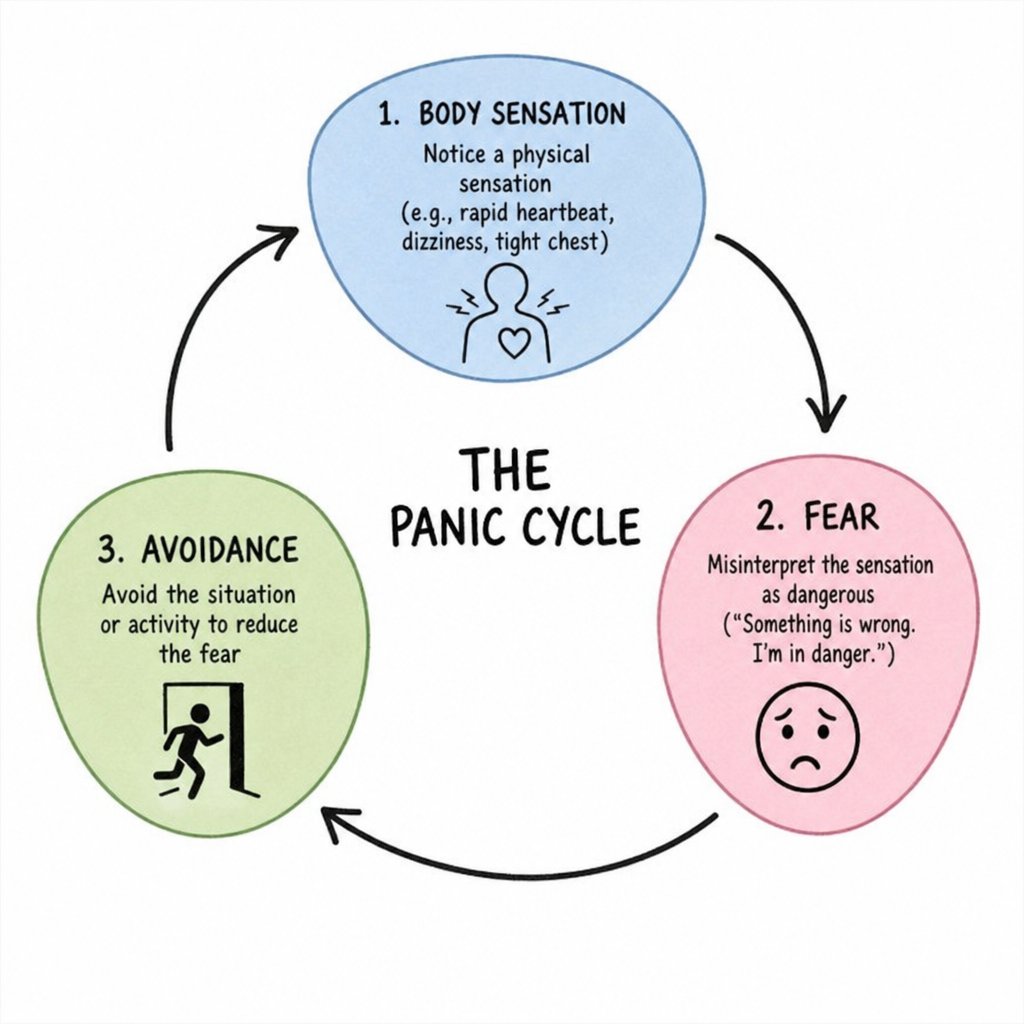
Panic tends to feed itself. You notice a sensation, like your heart skipping a beat. Your mind decides it means danger. That fear makes the sensation stronger, and next time you avoid whatever you were doing when it happened. Avoidance feels safe, but it keeps your brain convinced the threat was real, so the loop starts again.

Panic cycle diagram showing how to stop a panic attack by breaking the loop of body sensation, fear, and avoidance.
How panic keeps itself going: a sensation, a scary thought about it, then avoidance.

Wondering whether what you are feeling is panic, anxiety, or just a really hard season? Our free anxiety quiz takes a few minutes and can help you make sense of it. And if you would rather talk it through with a real person, that is exactly what we are here for.

How to stop a panic attack in the moment

Here is the part that surprises people: the fastest way through a panic attack is not fighting it. When you try to force every sensation away, your brain takes that as more evidence of danger. The goal is to ride the wave, quiet the scary thoughts, and let your body learn that this passes on its own. Most panic attacks peak within minutes and then begin to ease.

Six things that help:

  • Name it: tell yourself, this is panic. It feels intense, and it will pass.
  • Slow your exhale: breathe out a little longer than you breathe in, drop your shoulders, and let your breathing get steadier rather than perfect.
  • Come back to the room: notice five things you can see, four you can feel, and three you can hear.
  • Stop checking: taking your pulse over and over or searching your symptoms keeps the alarm going.
  • Stay if it is safe: if you can, remain where you are long enough for your brain to learn that panic passes without escaping.
  • Reach out in a way that builds you up: call someone if you need to, and look for support that helps you trust yourself, not reassurance you need every single time.

One important note. If you have never been checked by a doctor, or your symptoms feel different than usual, get medical care first. Chest pain, fainting, or trouble breathing that does not ease should always be taken seriously. These tools work best once a clinician has helped you understand what is happening in your body.

When to see a therapist for panic attacks

It is time to get support when the fear of the next attack starts making choices for you: skipping the train, turning down plans, avoiding the gym, or sleeping with your phone in your hand. Therapy also helps if you lean heavily on reassurance, feel scared of your own body, or still cannot trust a clean bill of health after a checkup.

The good news is that panic responds really well to treatment. Look for a therapist with experience in anxiety and panic disorder who uses evidence-based approaches like cognitive behavioral therapy (CBT) and exposure work. A good fit will explain the process clearly, move at a pace that stretches you without overwhelming you, and give you skills to practice between sessions. Our anxiety therapists in Chicago work exactly this way, in person in River West or online anywhere in Illinois.

Panic can make your world feel very small. It does not have to stay that way. Learning how to stop a panic attack is a real skill, and you do not have to learn it alone.

Questions about panic attacks

How long does a panic attack last?

Most panic attacks build quickly and peak within minutes, then gradually ease. You may feel shaky or worn out for a while afterward. If attacks keep coming back or last much longer, talk with a doctor or therapist.

Can you stop a panic attack once it starts?

You usually cannot switch it off instantly, but you can make it shorter and less frightening. Slowing your exhale, naming what is happening, grounding yourself in the room, and not fighting the sensations all help. Over time, therapy can make attacks less frequent.

What is the difference between a panic attack and an anxiety attack?

A panic attack is a clinical term for a sudden surge of intense fear with strong physical symptoms. Anxiety attack is not a formal diagnosis, and people use it for anything from building worry to a full panic attack. If you are not sure which you are experiencing, a therapist can help you sort it out.

Is a panic attack dangerous?

A panic attack feels frightening, but it is not physically harmful on its own. Because symptoms like chest pain and shortness of breath can overlap with heart and breathing problems, get checked by a doctor, and seek emergency care any time you are unsure.

Does therapy help with panic attacks?

Yes. Cognitive behavioral therapy, including gradual exposure to the sensations and situations you fear, is one of the most studied treatments for panic. Many people notice meaningful change with consistent work.

Understanding Anxiety: Causes and Coping Strategies

What does anxiety feel like?

Anxiety can feel like worry, fear, tension, or a sense that something bad is about to happen, even when there is no immediate danger. It can also show up physically, which is why many people first notice anxiety in their chest, stomach, breathing, muscles, or sleep. Anxiety disorders include conditions such as generalized anxiety disorder, panic disorder, social anxiety disorder, and phobia-related disorders, and symptoms can vary by person and situation. (nimh.nih.gov)

Common anxiety symptoms include:

  • Persistent worry or dread: thoughts keep looping, often around uncertainty, safety, health, performance, relationships, or the future.
  • Restlessness or feeling “on edge”: the body may feel keyed up, as if it cannot fully settle.
  • Trouble concentrating: anxious thoughts compete for attention, making reading, working, or conversations harder.
  • Sleep disruption: worry may delay sleep, cause early waking, or make sleep feel less restorative.
  • Muscle tension and headaches: the jaw, shoulders, neck, back, or stomach may hold stress.
  • Rapid heartbeat, sweating, trembling, dizziness, or shortness of breath: these can occur during spikes of fear or panic.
  • Avoidance: people may begin avoiding places, conversations, tasks, or decisions that trigger anxiety, which can shrink daily life over time.

Anxiety is not a character flaw or a lack of willpower. It is a real experience involving thoughts, emotions, body sensations, behaviors, and learned patterns of response. The good news is that those patterns can often be understood and managed with the right strategies and support.

The difference between everyday anxiety and an anxiety disorder

Everyday anxiety usually rises in response to a clear stressor and eases once the situation passes. For example, it is normal to feel nervous before a medical visit, a hard talk, or an important talk or presentation. That kind of anxiety may feel bad, but it stays tied to one event and does not take over most of life.

An anxiety disorder is more likely when fear or worry is frequent, too strong, hard to control, or out of proportion to the situation. It may also cause avoidance, panic attacks, ongoing body symptoms, or serious distress. A health care provider or mental health professional can check whether symptoms fit an anxiety disorder, another mental health concern, a medical issue, medication effects, substance use, or a mix of causes. (nimh.nih.gov)

A useful question is not whether you have anxiety. Most people do at times. A better question is whether anxiety is limiting life, harming health, or keeping you from what matters. If the answer is yes, coping skills can help, and professional care may be a good next step.

Why does anxiety happen?

Anxiety happens when the brain and body prepare for possible danger. The stress response can sharpen attention, speed the heart, tense muscles, and push the body toward action. Problems begin when that alarm becomes too sensitive, stays on too long, or reacts to thoughts and possibilities as if they are immediate threats.

Several factors can contribute:

  • Biology and temperament: some people are more sensitive to threat, uncertainty, or body signals.
  • Family history and genetics: anxiety disorders can run in families, although environment and learned behavior also matter.
  • Stressful or traumatic experiences: the nervous system may stay more alert after painful, uncertain, or overwhelming events.
  • Ongoing pressure: caregiving, money strain, conflict, health problems, discrimination, workload, or major life changes can keep stress high.
  • Thinking patterns: doom thinking, perfectionism, low tolerance for uncertainty, and what-if spirals can make symptoms worse.
  • Avoidance cycles: avoiding triggers brings short-term relief, but it can teach the brain that the situation was dangerous, which can make future anxiety stronger.

Understanding the cause is not about blame. It is about finding the best place to start change. For one person, sleep and caffeine may be the main triggers. For another, the key issue may be panic feelings, social fear, trauma reminders, or chronic worry.

A next step you can put into practice

Start by tracking your anxiety for one week. Write down the situation, the anxiety symptoms you noticed, what you did next, and whether it helped. Patterns usually become clearer on paper. You may see repeated triggers, find coping skills that work better than others, and notice small changes that are easier to choose.

Anxiety can feel convincing, but it is not always accurate. With grounding techniques for anxiety, supportive habits, and care when needed, it is possible to respond with more steadiness and less fear.

Q&A


How can I tell whether my anxiety is normal stress or something that needs more support?

Everyday anxiety usually has a clear trigger and settles once the situation passes. More support may be needed when it is frequent, too strong, hard to control, out of proportion, or starts getting in the way of sleep, work, school, relationships, health, or daily choices.

Why can anxiety cause physical symptoms like a racing heart or shortness of breath?

Anxiety turns on the body’s alarm system. When the brain senses possible danger, the stress response can speed the heart, tense muscles, change breathing, and sharpen attention. These reactions are meant to prepare the body for action, but they can feel scary when there is no clear threat.

Can lifestyle habits cure anxiety?

Sleep, movement, food, connection, and routine may not cure anxiety on their own, but they can lower the stress load that makes it easier to trigger. Small, steady habits, such as a short walk, planned worry time, or a calming bedtime routine, can make coping more manageable.

Overthinking is not a personality trait. What therapy for anxiety actually does

You replay the conversation from this morning on the train home, editing what you should have said. You have three versions of tomorrow’s meeting running before you have finished dinner. When your partner takes a beat too long to text back, you have already worked out what you did wrong. Friends call you thoughtful. Your boss calls you thorough. You call it overthinking, or “just how my brain works.”

We want to offer a different reading. Overthinking is not a personality. It is anxiety that has learned to look productive.

Why your brain does this

Anxiety is a prediction system. Its whole job is to spot what could go wrong before it does, and in a body that grew up needing to read the room, that system gets very good, very early. Overthinking is what it feels like from the inside when the prediction system will not turn off. It runs scenarios. It rehearses. It tries to solve tomorrow tonight, because somewhere along the way you learned that being caught off guard was not safe.

That last part matters. Most of the chronic overthinkers we meet in Chicago did not choose this. They came by it honestly, in families where the mood could turn, where love came with conditions, where being the one who noticed everything was how you stayed okay. The brain kept the skill and dropped the context. Now it scans a quiet Tuesday the way it once scanned a tense kitchen.

Gabor Maté puts it simply: the question is not why the anxiety, but why the anxiety made sense once. Therapy starts there, and it is a relief for most people to hear that their mind is not broken. It is loyal to a version of the world that no longer exists.

The tell: thinking that never lands

Healthy thinking goes somewhere. You consider a problem, you reach a decision, the thinking stops. Overthinking loops. You reach the decision and immediately reopen it. You solve the problem and then check whether you solved it right. The thinking does not end because its real purpose was never to solve anything. It was to feel less afraid, and thinking cannot do that. It can only postpone the feeling for another hour.

That is why the advice to “just stop overthinking” is useless. You are not overthinking because you lack willpower. You are overthinking because the alternative is sitting with the feeling underneath, and nobody ever showed you how.

What therapy for overthinking and anxiety actually does

People expect breathing exercises. There are some, and they help, and they are not the point.

The first thing we do is slow the loop down enough to see it. In session you learn to catch the moment the thinking starts, what set it off, and what feeling it is trying to outrun. Most people have never once looked at that feeling directly. When you do, with someone beside you, it turns out to be smaller and older than the thinking made it seem.

The second thing is updating the prediction system. Cognitive behavioral therapy is very good at this, and it is the most studied approach for anxiety we have. You test the catastrophe against what actually happens, over and over, until the brain gets the memo that the tense kitchen is not here anymore. This is not positive thinking. It is accurate thinking, which for an anxious brain is a bigger shift.

The third thing, and often the deepest, is working with the part of you that believes it has to stay on watch. In approaches like Internal Family Systems, we do not fight that part. We get curious about it. It has usually been protecting you since you were small. When it feels understood rather than attacked, it can rest, and the loop quiets in a way that no amount of willpower ever produced.

And through all of it, there is the simple fact of a room where you do not have to perform, manage, or pre-solve anything. For a lot of overthinkers, the therapy hour is the first hour in years where nothing is being scanned. The nervous system learns from that too.

What changes

People do not stop thinking. They stop looping. The email gets sent without eleven rereads. The text goes unanswered for twenty minutes and it is just a text. Decisions get made once. Sleep comes faster because the day’s meeting is not being held at 1am.

And something less measurable: you start to trust yourself. Not because you have planned for every outcome, but because you have learned that you can handle the one that shows up.

Where to start

If you want a first read, our anxiety check-in takes about three minutes and uses the same screening questions a therapist would ask. It is not a diagnosis. It is a way to see whether what you are carrying is in the range where support makes sense.

Our anxiety therapists in Chicago see overthinkers every day, many of them high functioning people whose anxiety is invisible to everyone but them. A free consultation is a fifteen minute call: you say what is going on, we tell you honestly who on our team fits. In person minutes from West Loop, Wicker Park and Bucktown, or online anywhere in Illinois. In network with BCBS, Cigna, Aetna and United.

You have spent years thinking your way around this. You do not have to think your way through it alone.

Your Job Might Not Be the Problem

Two colleagues in conversation at a small table beside an office window in daylight

You got a two line email from your manager. No greeting, no punctuation, just “can we talk later.”

And your whole day is over.

You reread it. You check their calendar. You go back through last week looking for the thing you did. You draft a reply, delete it, draft it again. By lunch you have constructed an entire narrative in which you are being managed out, and you have not eaten, and none of it has happened.

That loop has a name. It is anxiety, even when it never feels dramatic enough to call it that.

Here is the question worth sitting with. Is that email really what did this to you?

Work is where the old story gets retold

Most of us learned how to be a person inside a family. Long before we had language for it, we worked out what we had to do to stay in good standing. Be useful. Be easy. Be impressive. Do not need too much. Read the room before you speak.

Those were not personality traits. They were strategies. They were intelligent, and at the time they worked.

Then you grew up and walked into a building full of people who have power over your income, your schedule and your sense of being good at something. Someone evaluates you. Someone decides what you deserve. Someone can be pleased with you or disappointed in you, and you can feel the difference in your body before you can name it.

Of course the old strategies came with you. Where else would they go.

This is not a flaw in you and it is not a failure of professionalism. It is what the psychologist Alexandra Solomon calls relational self-awareness, the work of noticing that we bring our whole relational history into every room we enter, including the ones with a badge reader on the door.

The tell is the size of the reaction

You do not need to excavate your childhood to work with this. There is a much simpler signal, and you already have access to it. Notice when the reaction is bigger than the event.

A piece of feedback that was mildly critical and left you underwater for three days. A colleague who did not reply and you were certain they were angry. A win you could not enjoy for more than about eleven minutes. A meeting that ended fine and you replayed it at 2am anyway.

The size of the feeling is not proportional to the size of the thing. Which means the feeling is not really about the thing. That gap is the whole signal. When your response to something at work is out of scale with what actually occurred, something older just got touched.

Six signs it might not be about work

Your boss stops being a person and becomes a weather system. You are not managing a relationship with a colleague, you are monitoring a mood. You know their footsteps. You can tell what kind of day it will be from how they say good morning. That is a skill you learned somewhere else.

Feedback lands as a verdict on you, not on the work. Someone says the deck needs restructuring and you hear that you are not good at your job, and underneath that, something quieter about not being good. There is no gap between the critique and your worth.

You cannot ask for things. A day off. A clarification. Credit for something you did. Asking feels enormous and faintly dangerous, so you go without instead, and then you feel resentful about going without.

One person’s approval matters more than everyone else’s. There is usually one. You could get warmth from four colleagues and it would not touch the fact that this one person seemed short with you on Tuesday.

You are the one who absorbs. You take the extra work. You smooth the tension. You notice who is upset and you fix it before anyone asks. And you are quietly exhausted by a job description nobody wrote down.

Sunday is not a day. It is a countdown. The dread arrives before anything bad has happened, which is a fairly good clue that you are bracing for something you have already lived through.

If two or three of those landed, that is worth paying attention to. It does not mean your workplace is fine and you are the problem. Sometimes the job really is the problem. But if you have felt this way in three different jobs with three different managers, the common factor is worth a look.

What to do in the moment

The instinct is to fix the whole thing. Do not. These are smaller than you think, and that is the point.

  1. Name the age. When you feel the flood coming, ask yourself quietly, how old do I feel right now. Most people get an answer immediately, and it is rarely the age they are. That question does not solve anything, but it puts a small amount of daylight between you and the reaction, and daylight is what you need to make a different choice.
  2. Check the evidence out loud. “What I heard was that this needs to be redone. Did you mean the whole thing or the second section.” You are not being difficult. You are asking reality to confirm or deny the story, before you spend three days living inside it.
  3. Do not send from the flood. If your chest is tight, the message can wait an hour. Nothing at your job is as urgent as it feels at the moment your nervous system decides it is.
  4. Say the smaller true thing. Not “I feel undervalued and have for months.” Try “I want to make sure I understood that.” Small is not weak. Small is what you can actually do while your heart rate is up.

The part I want you to hear

That kid who learned to read the room, to over deliver, to never be a burden, is not something to get rid of.

They kept you safe. They are also the reason you notice things other people miss, and the reason you are good at your job, and the reason you are still here. The goal was never to evict them. It is to stop letting them run the meeting.

You are allowed to be someone who is very good at their work and also someone who flinches at a certain tone of voice. Both are true. Neither cancels the other.

And when you find yourself at 2am replaying a conversation that everyone else forgot by 5pm, you can put a hand on it and say, not unkindly, I know. That was scary once. It is not that now.

If your job has started costing you more than it should, and you are beginning to suspect it is not entirely about the job, that is exactly the thing therapy is good at. Our therapists in Chicago work this way, in person and online, and a first conversation is free.

When Your Brain Will Not Shut Off

Woman dancing with flowing red fabric

It is late, and you are lying there running a conversation from work through your head for the ninth time. Or you are in the shower building a small disaster out of one unanswered text. You know, in the part of your brain that still sounds like an adult, that this is not useful. Knowing that has never once stopped it.

Cognitive behavioral therapy has a reputation for being the “just think differently” approach, which is unfortunate, because that is not what it is. Nobody has ever calmed down by being told their thoughts are irrational. What CBT actually does is treat anxious thinking as a loop with several places you can interrupt it, and then teach you where the doors are.

Here are the ones worth knowing.

Find the actual prediction

Anxiety almost never announces itself as a prediction. It shows up as a mood, a tightness, a general sense that something is wrong. The first move in CBT is to make it say what it actually thinks is going to happen.

Not “I feel weird about the meeting.” Something more like “they are going to realize I am not good at this and I will be managed out by spring.”

This feels worse for about ten seconds. Then it usually feels better, because a vague dread has nowhere to go, and a specific prediction can be examined. Most anxious thoughts survive on being unexamined.

Ask what happens next, and keep going

Decatastrophizing sounds like a technique that would insult your intelligence. It does not, when you do it properly, because the point is not to talk yourself out of the fear. The point is to follow it all the way to the end instead of stopping at the worst image.

So: they realize I am not good at this. And then what? A conversation with my manager. And then what? Probably a plan, probably some discomfort. And then what?

Almost always you arrive somewhere survivable. Anxiety works by stopping the film at the scariest frame. Running it to the credits is not optimism, it is just finishing the thought.

Give the worry an appointment

This one sounds silly and has some of the better evidence behind it, particularly for the kind of anxiety that runs all day rather than spiking.

You pick a window, twenty or thirty minutes, ideally not right before bed. When a worry shows up outside that window, you write it down in a line or two and tell it you will get to it then. At the appointed time you sit down and worry on purpose.

Two things tend to happen. Some worries look much smaller in daylight with a pen in your hand. And the ones that still matter get your actual attention rather than a hundred half-thoughts spread across a Tuesday.

Test it instead of arguing with it

This is the one most people skip, and it is the one that changes things.

You can argue with an anxious thought all day and it will not move, because it was not built out of evidence in the first place. What moves it is new evidence. So if you believe people will notice you are nervous and think less of you, the CBT move is not to reassure yourself. It is to go in slightly under-prepared on purpose, and then find out.

Therapists call these behavioral experiments. You make the prediction specific, you do the thing, and you check what actually happened against what you expected. Your nervous system does not update from reasoning. It updates from experience.

Notice what is buying you relief

Here is the uncomfortable part. Most of us have small habits that make anxiety survivable in the moment, and those same habits are why it never resolves.

Rehearsing a conversation forty times. Getting to the airport four hours early. Texting someone to check they are not annoyed with you. Leaving the party after twenty minutes. Every one of those brings genuine relief, and every one teaches your brain that the relief is why nothing bad happened.

You do not have to give all of them up at once, and honestly, some of them are fine. But it is worth knowing which of your coping is actually maintaining the problem, because that is usually the difference between managing anxiety forever and turning it down.

What is honest about all this

CBT for anxiety has some of the strongest evidence in mental health, with most studies putting meaningful improvement somewhere in the range of six or seven people in ten. It is also usually delivered over something like twelve to twenty sessions with a person who can see the patterns you cannot.

What that means practically: you can absolutely start these on your own tonight, and some of them will help. What you cannot easily do alone is spot your own avoidance, because avoidance is invisible from the inside. It just feels like sensible planning.

If your worry has been running the show for a while, our anxiety check-in takes about two minutes and will tell you where you actually are. And if you would rather just talk to someone, our anxiety therapy team in Chicago is here.

Sources referenced: standard cognitive behavioral protocols for generalized anxiety and panic, including cognitive restructuring, decatastrophizing, stimulus-control worry postponement, behavioral experiments, and safety-behavior reduction.

Past the Point of Just Worrying; Therapy for Anxiety

Man in quiet reflection by a window

The truth is: anxiety is manageable. With the right tools and strategies woven into your daily life, you can take back control instead of letting anxiety call the shots.

We all worry. But an anxiety disorder is different—it lingers, it interferes, and it leaves you feeling like you’re never fully at ease. Here are some common signs you may be dealing with more than everyday stress:

  • Worrying takes up a large part of your day
  • You feel tense, on edge, or like something bad is always about to happen
  • You find yourself asking for constant reassurance from the people close to you
  • Trouble falling asleep or staying asleep because your mind just won’t shut off
  • Physical symptoms like muscle tension, digestive issues, racing heartbeat, sweating, or shortness of breath
  • You recognize your anxious thoughts aren’t always rational—but knowing that doesn’t make them go away
  • You feel on edge around others

If any of these resonate, it might be time to talk with someone who gets it.

How Anxiety Therapy Helps:

At Marra, we see therapy not as a last resort, but as a lifestyle—just as important as exercise, nutrition, or sleep. Anxiety therapy with us isn’t about “fixing” you. It’s about equipping you with the skills, self-awareness, and strategies to live with more clarity and calm.

Our therapists use evidence-based approaches—like CBT (Cognitive Behavioral Therapy), ACT (Acceptance and Commitment Therapy), and IFS (Internal Family Systems)—while keeping it grounded, human, and relatable. Think of it as a collaborative space where you’re not judged, you’re supported. Together, we’ll:

  • Build tools to quiet spiraling thoughts
  • Learn to tune into your body’s signals before they snowball
  • Unpack old patterns that keep fueling your anxiety
  • Create a lifestyle framework that supports your well-being long term

Why Choose Marra?

We’re not just therapists—we’re partners in your growth. Our team is diverse, modern, and intentional. We believe therapy is for everyone, not just when you’re in crisis. And because we’re a group practice, you’ll have access to a variety of therapists with different approaches and specialties—so we can match you with the right fit.

Take the Next Step

If anxiety has been stealing your peace of mind, your sleep, or your focus, you don’t have to wait until it gets worse. Therapy is a proactive way to care for yourself—just like a check-up or annual exam.

✨ Book a consultation today and let us connect you with a therapist who feels like the right fit. We offer in person or virtual visits. If you have more questions, head to our FAQ page.