About Elisa Brennecke

Elisa Brennecke is a licensed therapist and founder of Marra, a multi-niche trauma based practice in Chicago. Elisa has spent the majority of her career working with clients experiencing childhood attachment injuries and how that impacts their intimate relationships as adults.

4 Types of Therapy for Depression, Explained

Types of Therapy for Depression

There’s no single best therapy for depression. But there’s one that fits you specifically.

You’re not expected to walk into a consultation call having already picked it. Knowing the terms still helps, because it makes it easier to tell when someone is being specific with you and when they’re speaking in generalities.

Here’s the shape of it. CBT has the deepest research base of anything on this list, and that still doesn’t make it the right one for you. No single approach works for everyone, and depression that doesn’t budge under one method often moves under another. Most therapists blend approaches rather than running one in its pure form. And which one you end up in tends to matter less than whether you and your therapist actually work well together. There are four approaches below, running from short and structured to open-ended and long-term, plus how a therapist picks one and what happens if the first one turns out to be wrong.

What Are the 4 Types of Therapy for Depression?

All four have research behind them for depression itself, not just for general mental health support. Here’s each one in plain language.

1. Cognitive Behavioral Therapy (CBT)

CBT works on the loop between what you think, what you do, and how you feel. Depression runs a specific kind of inner commentary that can sound like plain truth. CBT treats that commentary as a set of habits. Things you can catch, question, and eventually change.

Sessions are structured. There’s an agenda, specific skills, and usually something to try before the next one. NIMH describes the approach as helping a person become aware of inaccurate or harmful automatic thinking, then change the patterns that follow from it.

CBT is the most heavily researched psychotherapy for depression. That doesn’t mean it works best for you. It means the evidence runs deepest, partly because structured treatments that follow a set script are the easiest kind to study.

CBT also puts real weight on what you do, not only on what you think. A lot of the early work is about getting activity back before the mood follows, because waiting for motivation almost never works. We’ve written more about that in what to do when nothing feels worth doing.

Sessions often move faster than people expect. Some people find that steadying after months of feeling unfocused. Others find it too clinical. Either reaction tells you something about fit.

2. Dialectical Behavior Therapy (DBT)

DBT started as a treatment for people whose emotions arrive at overwhelming intensity, and it’s been used more broadly since. It’s skills-based and concrete, built around four areas. Distress tolerance, for getting through the worst hours. Emotion regulation, for the intensity itself. Interpersonal effectiveness, for the relationships that intensity strains. And mindfulness, sitting underneath the other three.

For depression, DBT tends to fit best when low mood isn’t the only thing happening. If your depression comes with emotional swings, self-harm, or a sense that feelings hit you harder than they seem to hit everyone else, this approach was built for that.

The word “dialectical” describes the core idea. You’re doing the best you can, and you also need to change. Most people arrive believing they have to pick one. Usually the harsher one.

3. Acceptance and Commitment Therapy (ACT)

ACT parts ways with CBT on one key point. It cares less about whether a difficult thought is accurate, and more about whether wrestling with it is costing you your life.

The work is about carrying hard feelings while you keep moving toward what you care about, even when the feelings haven’t cleared. At the center of it sits a distinction between goals, which have finish lines, and values, which are directions you can move in on any given day.

This one tends to land with people who’ve done CBT, understood every word of it, and found that knowing a thought was distorted did nothing to loosen its grip.

4. Psychodynamic Therapy

Psychodynamic therapy looks underneath the symptoms, at the pattern that keeps producing the low mood. That might be what you learned early about your own worth, or whose approval you’re still working for, or anger you were never allowed to feel.

It’s less structured than CBT and it usually runs longer. There’s no fixed agenda for the hour, and the relationship between you and your therapist becomes part of the work, because patterns that show up everywhere else in your life tend to show up there too.

People often come to this one after something more structured helped for a while and then stopped. If your depression keeps coming back in the same shape, that shape is usually the thing to look at.

How Do the 4 Approaches Compare?

Here’s the quick version of what each one focuses on, how long it tends to run, and when it fits.

CBT works on thought and behavior patterns. It’s structured and often runs 12 to 20 sessions, and it fits when you want tools and structure fairly quickly. DBT works on emotional intensity and the skills for coping with it. It runs longer, usually with a skills component alongside the individual work, and it fits when low mood comes packaged with emotion that overwhelms you.

ACT works on values and on making room for difficult internal states. Length varies, usually medium-term, and it fits when you understand your thoughts perfectly well and are still stuck. Psychodynamic therapy works on the patterns underneath and on early relationships. It’s open-ended and longer-term by design, and it fits when the same depression keeps returning no matter what you throw at it.

If none of those obviously belong to you, that’s normal, and it isn’t something you have to sort out alone. Our depression check-in takes about two minutes and uses the PHQ-8, the same screening questions a clinician would open with. It’s an inventory, not a diagnosis, and it isn’t a substitute for talking to someone. It gives you a starting point rather than the whole picture, and it gives a clinician something concrete to work from on a first call.

Does the Type of Therapy Matter More Than the Therapist?

No. Across decades of outcome research, the most reliable predictor of whether therapy works isn’t which approach gets used. It’s the working relationship. Whether you trust them. Whether you agree on what you’re working on. Whether you can say the embarrassing thing out loud.

That doesn’t make the approach irrelevant. It does mean that picking a great method and a therapist you feel guarded around is the wrong trade. People make that trade constantly.

How Does a Therapist Decide Which Type to Use?

A therapist decides based on a full intake assessment. What comes out of it is usually a blend, because very few clinicians use a single method in its pure form.

A first session covers what the depression looks like day to day, how long it’s been running, what else is going on, and what you’ve already tried. A few things carry extra weight. How long it’s lasted. Whether you can currently manage basics like sleeping and eating. What’s already been tried and what actually happened when it was. And what you want out of treatment, which gets asked less often than it should.

Depression isn’t one thing, so we don’t treat it one way. Across our team, the work draws on cognitive behavioral therapy, dialectical behavior therapy, acceptance and commitment therapy, and psychodynamic therapy, and most of our clinicians move between them depending on what’s in front of them. You can see how that fits together on our depression therapy page.

How Does Depression Severity Affect the Treatment Approach?

Two people using the same approach can be having completely different experiences of it, and severity is usually why. How long it’s lasted, how much it’s affecting sleep, work, and relationships, and what else is going on all shape how treatment gets built.

For milder, shorter-term depression, weekly therapy on its own is often enough. For depression that’s run longer, keeps returning, or comes with safety concerns, therapy usually gets paired with other support. Sometimes a prescribing clinician, sometimes closer coordination between providers. That isn’t a sign your situation is worse than someone else’s. It just means more people are involved in the plan.

How you responded to treatment before matters too. If something helped and then stopped helping, that’s useful information for building what comes next. It isn’t a reason to start over from zero.

Can Different Types of Therapy Be Combined?

Yes, and combining them is closer to the norm than the exception. Very few clinicians practice a single named method in pure form.

In practice, that might look like CBT early to get you moving and give you something to hold onto, then psychodynamic work later on the pattern underneath. Or it might look like DBT skills for the emotional intensity alongside ACT work on what you actually want your life to look like.

Medication combines with all of these too. For moderate to severe depression, therapy and medication together tend to outperform either one alone. That’s a conversation to have with a prescribing clinician, not something to decide before treatment starts.

The blend should be deliberate, though. If you ask what’s being used and why, you should get a straight answer.

What If You’ve Tried Therapy Before and It Didn’t Work?

That’s useful clinical information. It doesn’t mean therapy can’t work for you, and bringing it up on a first call gives a therapist something real to work with.

Three things go wrong most often, and each one calls for a different response. Sometimes it’s the wrong approach, where the method just didn’t fit the problem, and a meaningfully different one makes more sense than running the same play again. Sometimes it’s the wrong fit, where the method may have been fine but the connection with that particular therapist wasn’t there, and a different person is the better next step. And sometimes it’s the wrong timing, where the basics weren’t in place or a crisis was taking up all the room the work needed.

Say which of those it felt like. A clinician who hears “I did six months of CBT, I understood all of it, and nothing shifted” has been handed something genuinely useful for deciding what to try next.

What Happens if the First Approach Doesn’t Fit?

You change it. Changing course is ordinary clinical practice. It isn’t a failure and it isn’t a restart.

Often the first approach helped for a while and then hit its limit. That’s information, not a setback. The key is saying it out loud, so ask any prospective therapist early how they handle it when something isn’t working.

A therapist who meets that question with openness is telling you the truth about how the next six months would go. So is one who doesn’t.

Frequently Asked Questions

Is CBT or DBT better for depression?

Neither is universally better. CBT usually fits when depression centers on thought patterns and rumination. DBT usually fits when depression comes with intense emotional swings, self-harm, or relationships strained by that intensity. The right one depends on what’s driving your depression, not on which method ranks higher in outcome studies.

Can different types of therapy for depression be combined?

Yes. Combining approaches is closer to the norm than the exception, since few therapists practice one method in pure form. A common pattern is CBT early to help you start moving and see your thinking clearly, then psychodynamic work later on what’s underneath it.

How long does each type take to work?

It varies. CBT is often structured around 12 to 20 sessions, and some of its early behavioral work can show movement within a few weeks. DBT usually runs longer, since the skills take time to build. ACT tends to sit in the middle. Psychodynamic therapy runs longest, with no fixed endpoint by design.

What kind of therapy is best for depression?

There isn’t one best type. CBT has the deepest research base, but that reflects how easy structured treatments are to study, not that it beats every option for every person. The best type is the one that matches what’s driving your depression, with a therapist you trust enough to be honest with.

What is the best therapy for severe depression?

Severe depression usually calls for more coordination, not a single named method. Therapy is often paired with a prescribing clinician, and CBT, DBT skills, or psychodynamic work may all play a role depending on what’s happening. Safety, sleep, and daily functioning typically get addressed before the modality becomes the main question.

What kind of therapist do I need for depression and anxiety?

Look for a therapist trained in approaches that address both, since they often show up together. CBT and ACT both treat depression and anxiety within the same framework. What matters most is a therapist who assesses both at intake, rather than treating them as two separate, unrelated problems.

Whichever approach you end up in, the first change usually isn’t feeling better. It’s having language for what’s happening and a plan you can point to. After that, what comes back first is range. Things get interesting again, or funny, or worth the effort of showing up for. That’s slower than most people want and steadier than they expect, and you’ll notice it before anyone else does.

Talk to a Marra Therapist About Your Options

You can’t reason your way to the right approach from an article, and you’re not supposed to. What an article can do is stop you from walking into the first call with no vocabulary at all.

A free consultation with Marra Therapy is fifteen minutes. You describe what’s going on, and we’ll tell you which of our clinicians works the way your depression seems to need, and why. We see clients in person minutes from West Loop, Wicker Park, and Bucktown, or online anywhere in Illinois.

Four approaches are a lot to hold. Sorting between them is our job, not yours.

If you’re having thoughts of harming yourself, please contact the 988 Suicide and Crisis Lifeline by calling or texting 988. It’s free, confidential, and available 24 hours a day.


Yesterday I went down a rabbit hole.

It started innocently enough. I’m a founder, and I’m competitive, and I told myself I was doing research: looking at what other practices were building, how they were growing, what they were launching. Somewhere along the way, it stopped being research. I wasn’t learning anymore. I was keeping score. And by the end of it, I didn’t feel inspired. I felt small.

If you’ve ever scrolled through someone’s promotion announcement, their beautiful new office, their book deal, their engagement, their “so grateful for this season” post, and closed the app feeling like you’re somehow losing a race you didn’t sign up for, this one is for you.

Comparison isn’t the problem. The spiral is.

Comparing ourselves to others is wired into us. Back in the 1950s, the psychologist Leon Festinger described what he called social comparison theory: we figure out how we’re doing, in part, by looking at the people around us. It’s how we’ve always oriented ourselves in a group.

So I’m not going to tell you to stop comparing. You won’t, and neither will I. What matters is what happens after the comparison. Research on envy shows it comes in two flavors. One kind motivates us: we see someone ahead and think, “I want that, and I can work toward it.” The other kind deflates us: we see someone ahead and think, “I’ll never get there, and something must be wrong with me.” Same trigger, completely different story.

Yesterday I was living in the second story.

There’s grief in it, too

When I slowed down enough to feel what was underneath, it wasn’t just jealousy. It was grief. Grief that I’m not there yet. Grief for the timeline I imagined for myself, the version of this business I thought I’d have by now.

I think we skip this part. We go straight from “they have it” to “what’s wrong with me,” and we never pause to let ourselves be sad about the gap. But grief deserves a little room. You’re allowed to want something and ache that it hasn’t happened yet. That ache doesn’t mean you’re failing. It means you care.

The feeling was younger than I am

Here’s what I noticed when I really sat with it: the “I’m not good enough” spiral didn’t feel like a 40-something founder talking. It felt young. Like a much younger version of me, scanning the room, trying to figure out if she measured up, if she was worthy of being chosen.

That’s often the tell. When a feeling is way bigger than the situation in front of you, it’s usually not about the situation in front of you. Someone else’s success didn’t create that wound. It just pressed on a bruise that was already there.

So I asked myself a simple question: how old do I feel right now? And the answer helped me separate what was happening today from what was being stirred up from a long time ago.

Coming back to my adult self

Getting out of the spiral didn’t come from talking myself into feeling amazing. It came from coming back to the adult version of me. The one who has built something real. The one who knows how hard this work is. The one who can hold that younger part with compassion instead of letting her drive the car.

Sometimes that looks like putting my feet on the floor and taking a breath. Sometimes it’s saying out loud, “I’m an adult, I’m safe, and this is just a feeling.” Sometimes it’s texting a friend who knows me. Nothing fancy. Just a return.

Change the questions you’re asking

When I’m in the spiral, my questions sound like this: Why am I not there yet? What am I doing wrong?

Those questions feel productive, but they’re really just self-criticism wearing a trench coat. They don’t lead anywhere useful.

So I swap them out. Instead I ask: What can I learn from what I’m witnessing? And I remind myself that I have no idea what that person is carrying. I don’t know what they sacrificed, what help they had, what debt they took on, what it cost them, or what they’re struggling with that never makes it to Instagram. I’m comparing my full, messy inside to their curated outside.

And then the most useful question of all: what’s one thing from their playbook I could apply at the scale I’m at right now? Not their scale. Mine.

If you’ve done any therapy, you might recognize this. It’s a core piece of CBT called cognitive restructuring: noticing the automatic thought, questioning whether it’s actually true, and replacing it with something more accurate and more helpful. I realized I’d been doing it without even naming it.

A few shifts that actually help

Treat envy as information. Envy is pointing at something you want. Instead of shaming yourself for feeling it, get curious. What exactly did you want in what you saw? Sometimes the answer surprises you, and sometimes you realize you don’t actually want their life at all, just one piece of it.

Compare yourself to who you were a year ago. That’s the only comparison that tells you anything true about your growth. Pull up an old calendar or an old journal entry and look at how far you’ve come.

Research with intention, not on autopilot. There’s a difference between “I’m going to spend 20 minutes studying how three practices structure their services” and an hour of wandering scrolling. Set the purpose and the timer before you open the tab. When the learning stops, close it.

Find the next step, not the whole staircase. Their success is the result of hundreds of small decisions you’ll never see. You don’t need to catch up to all of them. You need to take your next one.

Let the grief be there. If you’re sad you’re not further along, say so. To yourself, to a friend, to your therapist. Feelings that get named tend to loosen their grip.

Where I landed

By the end of the day, the person whose work sent me spiraling hadn’t changed at all. What changed was the question I was asking. I went from “why not me” to “what can I learn,” and from a scared younger version of me back to the grown woman who’s actually running this thing.

You’re not behind. You’re on your own timeline, carrying your own story, building at your own scale. And the fact that someone else’s success stirs something in you just means you still want big things for your life. That’s not a flaw. That’s a pulse.

16 Questions to Ask a Depression Therapist Before You Book

Questions to Ask a Depression Therapist

Most people walk into a consultation call with no plan, spend fifteen minutes answering questions, then hang up no clearer on whether this person can help them.

Across decades of research, the working relationship between client and therapist is one of the strongest predictors of whether therapy helps. Fit does about as much work as credentials do, sometimes more. So in a short call, you’re really trying to work out if this is someone you could tell the truth to, and that means knowing what to ask going in. A free consult is exactly the right place to ask all of it. A good therapist expects these questions and answers them without hesitating. A couple of them matter more for depression than they would for therapy in general, like whether someone has worked with your particular version of it and how they’ll know if it’s helping.

Here are 16 questions to ask a depression therapist.

Questions About Their Approach to Depression

1. What approach do you use for depression, and why?

Push for specifics. A label on its own tells you very little, so listen for why a given approach fits depression in particular, something like:

  • Cognitive behavioral therapy, for the inner critic that never clocks out
  • Behavioral activation, for rebuilding the link between doing something and feeling it
  • Psychodynamic work, for the pattern underneath that keeps feeding the depression

“I pull a bit from everything” isn’t automatically a red flag. It just leaves you with very little to go on.

2. How do you measure if therapy is working?

Almost nobody asks this one, and it sorts therapists fast. Strong answers point to something concrete: symptom scales at regular points, a check-in at a set interval, or goals named at the start and looked at again later.

Weaker answers stop at “you’ll feel it.” You might feel it eventually. But depression distorts your read on whether anything is getting better, which is exactly why an outside marker helps.

3. Have you worked with clients whose depression looks like mine?

Depression isn’t one thing. Different versions of it call for different familiarity, even though they share a diagnosis:

Specific experience beats general longevity here. Ten years of broad practice counts for less than three years spent with the exact thing you’re describing. Say what yours looks like and listen to how specifically they answer. Someone who recognizes the pattern will tell you so in detail.

4. What does a typical course of treatment look like?

A reasonable answer gives you a rough shape and a checkpoint, something like:

  • Weekly sessions to start
  • A reassessment somewhere around session eight to twelve
  • An early phase that looks different from the later work

Questions About Credentials and Fit

5. What license do you hold, and what does that mean for my care?

You’ll come across LCSW, LCPC, LPC, LSW, and PsyD, among others. All of them are licensed to treat depression. The differences mostly come down to training background and the lens someone tends to bring.

6. Are you fully licensed, or working under supervision?

Clinical fellows and associate-level clinicians are trained therapists still finishing supervised hours toward full licensure.

They usually cost less, and a supervisor reviews your case alongside them. For a lot of people, that combination works well.

7. What happens if I don’t think it’s working after a few sessions?

Listen for whether the answer sounds open or defensive. A strong one sounds like this: tell me, and we’ll either adjust the approach or help you find someone who fits better. A therapist who treats that question as a challenge has just told you something useful about how the next six months would go.

8. Do you have experience working with people from my background or identity?

Ask directly about experience with clients whose culture, race, religion, gender identity, sexuality, or family structure shapes how depression shows up for them. You’re trying to find out if this person can offer care that fits your actual life, and whether you’d feel comfortable naming the parts of it that matter. Someone with real experience here will answer specifically, not with a general claim about being inclusive.

Questions About Logistics

9. What is your fee, and do you take my insurance?

Ask for the self-pay rate and the in-network answer separately. A practice can accept your carrier and still have your specific plan out of network. Much easier to sort out before you book than after.

10. Do you offer telehealth, in person, or both?

Decide this before the call so you aren’t working it out live. Some people need the room. Others show up far more reliably from their own sofa, and the honest answer is whichever one you’ll actually keep doing. At Marra Therapy, you can do either: in person in Chicago, or online anywhere in Illinois.

11. What is your cancellation policy?

Ask for the window and the fee. Twenty-four or forty-eight hours is standard, and late-cancellation fees usually aren’t covered by insurance.

12. How soon can I start?

If your symptoms are getting worse, say so on the call. A three-week wait for the right fit is sometimes the correct choice. Sometimes the right answer is whoever can see you on Thursday.

13. What happens after this call?

A practice with its house in order will spell out a clear next step. That means telling you who follows up, when to expect it, and what they need from you before then.

Questions About What Therapy Will Actually Be Like

14. What does a typical session with you look like?

Ask whether sessions tend to be structured, conversational, skills-based, or some mix of all three. No format is correct for everyone. What you want is a realistic picture of what 45 to 60 minutes with this person will actually feel like, not a textbook description of therapy in general.

15. Do you give clients anything to work on between sessions?

Some therapists assign exercises, journaling, or specific behavioral steps. Others don’t work that way at all. Neither is wrong, but knowing which one you’re getting tells you whether their level of structure matches how you want to work.

16. How do you handle communication between sessions?

Ask about email, messaging, and what happens if something comes up before your next appointment. Therapists have real boundaries here and they vary a lot. Better to know them going in than to assume an availability that isn’t there.

How to Use This List on Your Consult Call

Bring the list, or at least remember the shape of it. If time is short, start with the approach and credentials questions, since those tell you the most in the least time.

You don’t need to ask all 16. A consult call runs fifteen minutes, and covering four or five well beats rushing the whole list. Pick the ones that matter most to what you’re dealing with and save the rest for a first session.

What Should You Pay Attention to During the Therapist’s Answers?

How the conversation feels matters as much as what gets said. Look for clear explanations, real listening, and comfort talking about your specific concerns. Credentials and expertise matter, but feeling safe enough to speak openly is just as much a part of fit.

Signs of a Strong Therapist Fit

A strong fit usually looks like this. The therapist listens without taking over the conversation, answers your questions clearly, respects your boundaries, explains how they actually work, and leaves room for your goals instead of bringing their own agenda.

Signs You May Want to Consider Another Therapist

Watch for a few specific patterns: dismissing your concerns more than once, interrupting or dominating the call, unclear boundaries, pressure to commit before you’re ready, or defensiveness when you ask a reasonable question about how they work. One of these on its own isn’t necessarily disqualifying. The pattern is worth trusting.

Once you’ve picked someone, the first stretch is quieter than people expect. You spend a few sessions telling them what’s been going on, they start to see the shape of it, and somewhere in there you find yourself saying things out loud you’d only ever thought. What moves first isn’t mood. It’s the relief of having a plan, and of someone else holding part of it with you. Small thing to feel. It changes how the rest of the work goes.

Ready to Ask Marra Therapy These Questions?

Bring the list. Don’t worry about seeming difficult.

A free consultation with Marra Therapy is fifteen minutes with our intake team. You tell us what’s going on, you ask whatever you want to ask, and we’ll tell you honestly which of our therapists fits what you’re dealing with. If the answer is nobody here, we’ll say that too.

Asking how someone works before you trust them with this isn’t being difficult. It’s the sensible thing to do.

If you’re having thoughts of harming yourself, please contact the 988 Suicide and Crisis Lifeline by calling or texting 988. It’s free, confidential, and available 24 hours a day.

How to Stop a Panic Attack: What Causes Them and What Actually Helps

If you are searching for how to stop a panic attack, there is a good chance you have already had one. Maybe your heart started pounding in the middle of a meeting, or you woke up at 2 a.m. unable to catch your breath and sure something was very wrong. So let me start with what I wish everyone knew: panic attacks are terrifying, and they are not dangerous. They are common, they are treatable, and having them says nothing about how strong you are.

A panic attack is a sudden wave of intense fear that shows up in your body, often as a racing heart, sweating, shaking, a tight chest, or trouble breathing, even when nothing around you is actually a threat. Below I walk through why panic happens, the cycle that keeps it coming back, what to do in the moment, and when it makes sense to get support.

Why panic attacks happen

Panic is your body’s alarm system going off when there is no fire. Your brain senses a threat, and your body does exactly what it was built to do: your heart speeds up, your breathing gets faster, your muscles tighten. Those are normal survival changes. The trouble starts when we read them as proof that something awful is happening. According to Mayo Clinic, the exact causes of panic attacks are not fully known, but genetics, major stress, temperament, and changes in how parts of the brain work may all play a role.

A few things tend to make panic more likely:

  • Stress load: ongoing pressure, loss, conflict, burnout, or big life changes can leave your nervous system on a hair trigger.
  • Fear of body sensations: if you watch your heartbeat, breathing, or dizziness closely, those sensations can start to feel like danger.
  • Avoidance: staying away from places where panic happened brings relief in the short term, but it also teaches your brain that those places are unsafe.
  • Caffeine, alcohol, and other substances: stimulants, some drugs, alcohol withdrawal, or medication side effects can create anxiety-like feelings.
  • Medical conditions: thyroid problems, heart rhythm issues, asthma, and balance problems can mimic or worsen panic, which is why a checkup matters.

You do not need to find one single cause before you get help. What matters more is understanding the cycle, because once you can see it, you can start to interrupt it.

The panic cycle

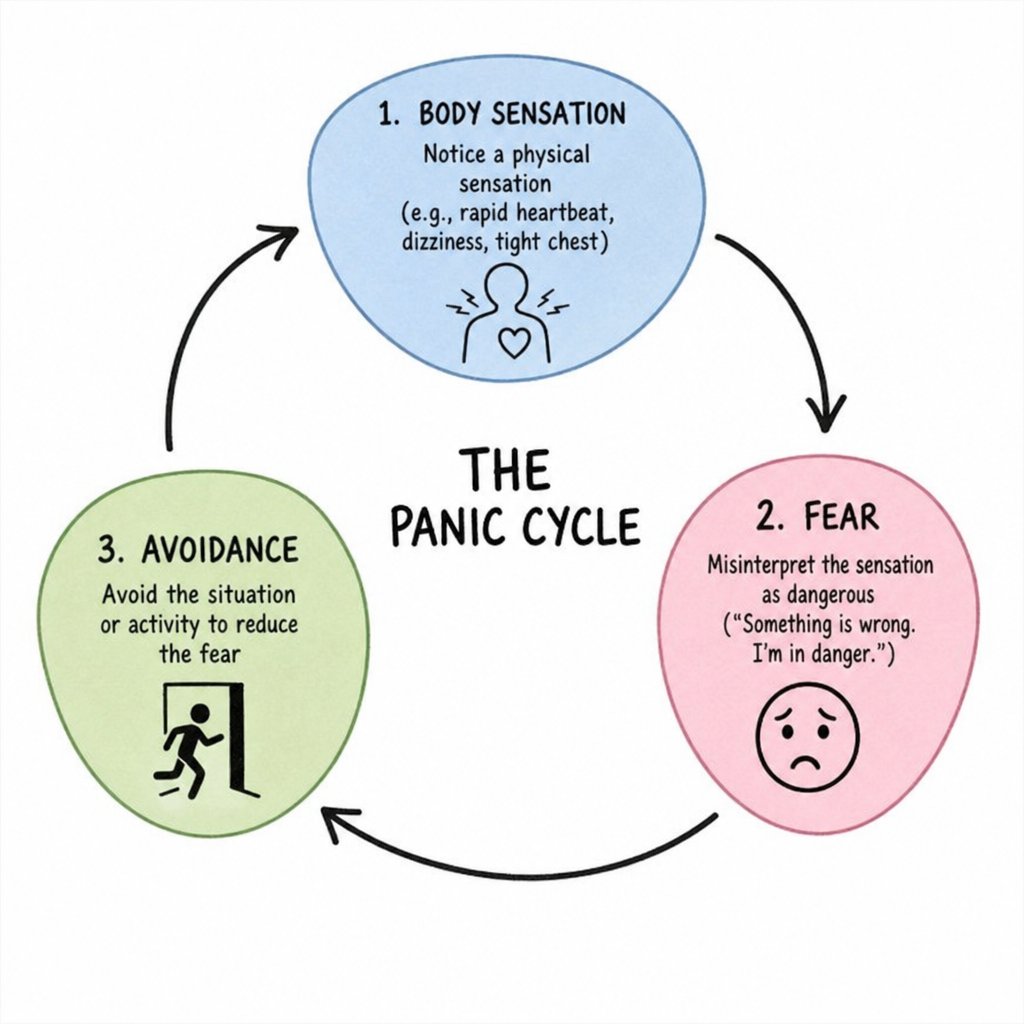
Panic tends to feed itself. You notice a sensation, like your heart skipping a beat. Your mind decides it means danger. That fear makes the sensation stronger, and next time you avoid whatever you were doing when it happened. Avoidance feels safe, but it keeps your brain convinced the threat was real, so the loop starts again.

Panic cycle diagram showing how to stop a panic attack by breaking the loop of body sensation, fear, and avoidance.
How panic keeps itself going: a sensation, a scary thought about it, then avoidance.

Wondering whether what you are feeling is panic, anxiety, or just a really hard season? Our free anxiety quiz takes a few minutes and can help you make sense of it. And if you would rather talk it through with a real person, that is exactly what we are here for.

How to stop a panic attack in the moment

Here is the part that surprises people: the fastest way through a panic attack is not fighting it. When you try to force every sensation away, your brain takes that as more evidence of danger. The goal is to ride the wave, quiet the scary thoughts, and let your body learn that this passes on its own. Most panic attacks peak within minutes and then begin to ease.

Six things that help:

  • Name it: tell yourself, this is panic. It feels intense, and it will pass.
  • Slow your exhale: breathe out a little longer than you breathe in, drop your shoulders, and let your breathing get steadier rather than perfect.
  • Come back to the room: notice five things you can see, four you can feel, and three you can hear.
  • Stop checking: taking your pulse over and over or searching your symptoms keeps the alarm going.
  • Stay if it is safe: if you can, remain where you are long enough for your brain to learn that panic passes without escaping.
  • Reach out in a way that builds you up: call someone if you need to, and look for support that helps you trust yourself, not reassurance you need every single time.

One important note. If you have never been checked by a doctor, or your symptoms feel different than usual, get medical care first. Chest pain, fainting, or trouble breathing that does not ease should always be taken seriously. These tools work best once a clinician has helped you understand what is happening in your body.

When to see a therapist for panic attacks

It is time to get support when the fear of the next attack starts making choices for you: skipping the train, turning down plans, avoiding the gym, or sleeping with your phone in your hand. Therapy also helps if you lean heavily on reassurance, feel scared of your own body, or still cannot trust a clean bill of health after a checkup.

The good news is that panic responds really well to treatment. Look for a therapist with experience in anxiety and panic disorder who uses evidence-based approaches like cognitive behavioral therapy (CBT) and exposure work. A good fit will explain the process clearly, move at a pace that stretches you without overwhelming you, and give you skills to practice between sessions. Our anxiety therapists in Chicago work exactly this way, in person in River West or online anywhere in Illinois.

Panic can make your world feel very small. It does not have to stay that way. Learning how to stop a panic attack is a real skill, and you do not have to learn it alone.

Questions about panic attacks

How long does a panic attack last?

Most panic attacks build quickly and peak within minutes, then gradually ease. You may feel shaky or worn out for a while afterward. If attacks keep coming back or last much longer, talk with a doctor or therapist.

Can you stop a panic attack once it starts?

You usually cannot switch it off instantly, but you can make it shorter and less frightening. Slowing your exhale, naming what is happening, grounding yourself in the room, and not fighting the sensations all help. Over time, therapy can make attacks less frequent.

What is the difference between a panic attack and an anxiety attack?

A panic attack is a clinical term for a sudden surge of intense fear with strong physical symptoms. Anxiety attack is not a formal diagnosis, and people use it for anything from building worry to a full panic attack. If you are not sure which you are experiencing, a therapist can help you sort it out.

Is a panic attack dangerous?

A panic attack feels frightening, but it is not physically harmful on its own. Because symptoms like chest pain and shortness of breath can overlap with heart and breathing problems, get checked by a doctor, and seek emergency care any time you are unsure.

Does therapy help with panic attacks?

Yes. Cognitive behavioral therapy, including gradual exposure to the sensations and situations you fear, is one of the most studied treatments for panic. Many people notice meaningful change with consistent work.

Understanding Anxiety: Causes and Coping Strategies

What does anxiety feel like?

Anxiety can feel like worry, fear, tension, or a sense that something bad is about to happen, even when there is no immediate danger. It can also show up physically, which is why many people first notice anxiety in their chest, stomach, breathing, muscles, or sleep. Anxiety disorders include conditions such as generalized anxiety disorder, panic disorder, social anxiety disorder, and phobia-related disorders, and symptoms can vary by person and situation. (nimh.nih.gov)

Common anxiety symptoms include:

  • Persistent worry or dread: thoughts keep looping, often around uncertainty, safety, health, performance, relationships, or the future.
  • Restlessness or feeling “on edge”: the body may feel keyed up, as if it cannot fully settle.
  • Trouble concentrating: anxious thoughts compete for attention, making reading, working, or conversations harder.
  • Sleep disruption: worry may delay sleep, cause early waking, or make sleep feel less restorative.
  • Muscle tension and headaches: the jaw, shoulders, neck, back, or stomach may hold stress.
  • Rapid heartbeat, sweating, trembling, dizziness, or shortness of breath: these can occur during spikes of fear or panic.
  • Avoidance: people may begin avoiding places, conversations, tasks, or decisions that trigger anxiety, which can shrink daily life over time.

Anxiety is not a character flaw or a lack of willpower. It is a real experience involving thoughts, emotions, body sensations, behaviors, and learned patterns of response. The good news is that those patterns can often be understood and managed with the right strategies and support.

The difference between everyday anxiety and an anxiety disorder

Everyday anxiety usually rises in response to a clear stressor and eases once the situation passes. For example, it is normal to feel nervous before a medical visit, a hard talk, or an important talk or presentation. That kind of anxiety may feel bad, but it stays tied to one event and does not take over most of life.

An anxiety disorder is more likely when fear or worry is frequent, too strong, hard to control, or out of proportion to the situation. It may also cause avoidance, panic attacks, ongoing body symptoms, or serious distress. A health care provider or mental health professional can check whether symptoms fit an anxiety disorder, another mental health concern, a medical issue, medication effects, substance use, or a mix of causes. (nimh.nih.gov)

A useful question is not whether you have anxiety. Most people do at times. A better question is whether anxiety is limiting life, harming health, or keeping you from what matters. If the answer is yes, coping skills can help, and professional care may be a good next step.

Why does anxiety happen?

Anxiety happens when the brain and body prepare for possible danger. The stress response can sharpen attention, speed the heart, tense muscles, and push the body toward action. Problems begin when that alarm becomes too sensitive, stays on too long, or reacts to thoughts and possibilities as if they are immediate threats.

Several factors can contribute:

  • Biology and temperament: some people are more sensitive to threat, uncertainty, or body signals.
  • Family history and genetics: anxiety disorders can run in families, although environment and learned behavior also matter.
  • Stressful or traumatic experiences: the nervous system may stay more alert after painful, uncertain, or overwhelming events.
  • Ongoing pressure: caregiving, money strain, conflict, health problems, discrimination, workload, or major life changes can keep stress high.
  • Thinking patterns: doom thinking, perfectionism, low tolerance for uncertainty, and what-if spirals can make symptoms worse.
  • Avoidance cycles: avoiding triggers brings short-term relief, but it can teach the brain that the situation was dangerous, which can make future anxiety stronger.

Understanding the cause is not about blame. It is about finding the best place to start change. For one person, sleep and caffeine may be the main triggers. For another, the key issue may be panic feelings, social fear, trauma reminders, or chronic worry.

A next step you can put into practice

Start by tracking your anxiety for one week. Write down the situation, the anxiety symptoms you noticed, what you did next, and whether it helped. Patterns usually become clearer on paper. You may see repeated triggers, find coping skills that work better than others, and notice small changes that are easier to choose.

Anxiety can feel convincing, but it is not always accurate. With grounding techniques for anxiety, supportive habits, and care when needed, it is possible to respond with more steadiness and less fear.

Q&A


How can I tell whether my anxiety is normal stress or something that needs more support?

Everyday anxiety usually has a clear trigger and settles once the situation passes. More support may be needed when it is frequent, too strong, hard to control, out of proportion, or starts getting in the way of sleep, work, school, relationships, health, or daily choices.

Why can anxiety cause physical symptoms like a racing heart or shortness of breath?

Anxiety turns on the body’s alarm system. When the brain senses possible danger, the stress response can speed the heart, tense muscles, change breathing, and sharpen attention. These reactions are meant to prepare the body for action, but they can feel scary when there is no clear threat.

Can lifestyle habits cure anxiety?

Sleep, movement, food, connection, and routine may not cure anxiety on their own, but they can lower the stress load that makes it easier to trigger. Small, steady habits, such as a short walk, planned worry time, or a calming bedtime routine, can make coping more manageable.

Does Insurance Cover Depression Therapy in Chicago?

Does Insurance Cover Depression Therapy in Chicago

Yes. If your plan covers medical care, it almost certainly covers depression therapy, and under federal parity law it can’t make that coverage harder to use than the coverage for a broken wrist.

But the real question isn’t whether you’re covered. It’s what your specific plan leaves you paying. In Chicago that usually means an in-network copay of $20 to $40 a session on a plan with no deductible. Medicaid plans, including Blue Cross Community, cover outpatient mental health as standard rather than as an exception, and prior authorization is rarely required for routine therapy. Out-of-network works differently, since you pay up front and chase partial reimbursement afterward. One call to the number on your insurance card tells you which of these you’re in.

We see this constantly. Someone assumes the answer is bad news, and the assumption quietly becomes the reason they don’t start. Insurance is confusing enough that avoiding it feels reasonable. But the few minutes it takes to check is usually the difference between guessing and knowing.

Here’s the parity law in plain terms, what actually changes between in-network and out-of-network care, which Chicago plans typically cover therapy, how to verify your own benefits, and what to do if your plan falls short.

Why Is Depression Therapy Covered by Insurance?

Depression therapy is covered because of the Mental Health Parity and Addiction Equity Act. It says that when a health plan covers mental health care, it can’t apply stricter rules to that care than it applies to medical and surgical care.

In practice, that means an insurer can’t charge you a higher copay for a therapy session than for a specialist visit, can’t cap your therapy sessions at a number it would never apply to physical therapy, and can’t bury mental health behind prior-authorization requirements it doesn’t use elsewhere. HealthCare.gov sets out what marketplace plans have to include, which covers behavioral health treatment, inpatient mental health services, and substance use treatment, with no yearly or lifetime dollar caps.

That’s the floor, and your plan may sit well above it. What parity guarantees is that mental health isn’t treated as the lesser category, which for a long time it openly was. What it doesn’t guarantee is a specific dollar amount, which is where the next distinction comes in.

What Changes Between In-Network and Out-of-Network Therapy?

In-network means your therapist’s practice has a contract with your insurer, so you pay a copay and the insurer pays the rest directly. Out-of-network means no contract exists, so you pay the full rate up front and seek partial reimbursement afterward.

The contract is doing more work here than people realize. When a practice is in-network, the insurer has agreed on a rate with them, and everything on your side gets measured against that contracted rate rather than against the practice’s full self-pay fee. So if your plan has a deductible, you’re paying down that contracted rate until it’s met, not the number on the practice’s fee schedule. This is the most common misunderstanding we hear, and it usually makes people overestimate what they’d owe.

Plenty of plans have no deductible at all for outpatient mental health. On those, it’s just your copay from the first session, with insurance covering the rest. In Chicago that copay typically runs $20 to $40. You never see the full fee, and the amount is set by your plan rather than by the practice.

Some plans use coinsurance instead of a flat copay, meaning you pay a percentage of the contracted rate, often after your deductible is met, rather than a fixed dollar amount each visit.

Out-of-network works differently again. You pay the therapist’s rate, then submit a superbill, an itemized receipt carrying the diagnosis and procedure codes your insurer needs. Depending on your out-of-network benefits, you may get a meaningful percentage back. You may also get nothing at all, which is why this is worth confirming before rather than after.

Which Chicago Insurance Plans Typically Cover Depression Therapy?

Most major plan types active in Chicago cover outpatient therapy as standard, including commercial employer plans and Medicaid managed care plans.

Employer plans are the most common route, and they generally cover outpatient mental health with a copay. Blue Cross Blue Shield of Illinois is the largest carrier in the state by a wide margin, which is why searching for a Blue Cross therapist in Chicago is so common. Aetna, Cigna, and UnitedHealthcare all hold a substantial share here too. Medicaid managed care plans, including Blue Cross Community Health Plans, cover outpatient mental health as well. That one is worth clearing up, because Medicaid coverage of therapy is real rather than a courtesy.

No page can tell you whether a given practice is contracted with your particular plan, because contracts change and plan names within a single carrier vary enormously. You verify that yourself, and it’s easier than it sounds.

How to Check Your Specific Plan

Call the member services number on the back of your insurance card. Your insurer is the only one who can tell you what you’ll owe.

Ask specifically about outpatient mental health benefits and use the billing code 90837, individual psychotherapy of 53 minutes or more. Ask what your copay is, whether your plan has a deductible, and how much of it you’ve met this year.

Ask whether there are session limits or prior-authorization requirements for outpatient therapy. For routine outpatient care the answer is usually no on both counts, but you want that on the record before you start.

Write down the name of whoever you spoke to and the date. It costs nothing, and it settles disputes later.

What Isn’t Always Covered?

Coverage gaps do exist. Extended sessions beyond the standard length are sometimes billed differently and may not be fully covered. Couples and family therapy sits in a genuinely murky space, since insurers often treat relationship work as not medically necessary unless it’s tied to a diagnosed condition in one partner. Some specialty modalities and intensive formats require separate authorization.

And if you’re seeing someone out of network, your reimbursement depends entirely on whether your plan includes out-of-network benefits at all. Not every plan does.

For insurance to pay, your therapist has to submit a diagnosis, and that diagnosis goes into your claims record. For the overwhelming majority of people this has no practical consequence, and parity law prevents it from being used to deny you coverage. Some clients still prefer to self-pay specifically to keep the work off the record. That’s a reasonable preference, not a paranoid one.

What If Your Plan Doesn’t Cover It?

You still have routes, and they’re usually better than people expect. Self-pay rates in Chicago generally run $165 to $200 per session and are typically eligible for FSA and HSA funds. Employer assistance programs often cover a short run of sessions at no cost, and plenty of people have that benefit and don’t know it.

Lower cost care exists too, though it looks different from practice to practice. We don’t run a published sliding scale, so there’s no tier to qualify for and no income paperwork. What we can sometimes do is low cost or pro bono care with one of our master-level clinical fellows, depending on your circumstances and who has room. It’s decided case by case, in a conversation, so the only way to know is to ask.

Frequently Asked Questions

Is depression a covered diagnosis?

Yes. Depression is a recognized mental health diagnosis, and under federal parity law, insurers can’t treat it differently from a medical condition. Documenting the diagnosis is a normal part of billing, not a special hurdle. The vast majority of plans, including commercial and Medicaid plans, cover outpatient therapy for depression as standard.

How many therapy sessions does insurance cover per year?

Most plans don’t cap outpatient mental health sessions at a specific number, since parity law prevents insurers from applying stricter limits to mental health than to medical care. Some plans still require periodic review for ongoing treatment. Call the number on your card and ask directly whether your plan sets any session limit.

Do I need a referral to see a therapist?

Usually not. Most plans let you see a therapist directly without a referral from a primary care doctor. Some do require one, so it’s worth confirming with your specific plan before booking. If a referral is needed, your primary care doctor can usually provide one quickly.

What if my therapist is out-of-network?

You’ll pay the full session rate up front, then submit a superbill to your insurer for partial reimbursement, if your plan includes out-of-network benefits. Reimbursement amounts vary widely by plan, so ask your insurer what percentage they cover and whether your deductible applies before assuming you’ll get money back.

Is therapy 100% covered by insurance?

Rarely completely free, though on a plan with no deductible your cost is often just the copay. Even with strong coverage, you may owe a set amount per session, or a percentage of the contracted rate until you meet your deductible. The specific number depends entirely on your plan, which is why checking before your first session matters.

How do I tell if my insurance covers therapy?

Call the number on the back of your insurance card and ask about outpatient mental health benefits specifically, using the billing code 90837. Ask about your copay, whether your deductible applies, and whether session limits exist. That one call gives you a real answer instead of a guess.

Can I get a therapist through my insurance?

Yes, most insurers keep a directory of in-network therapists, though it’s worth verifying directly since directories often lag behind actual provider status. Calling a practice and asking if they take your specific plan, then confirming with your insurer, is more reliable than trusting a directory alone.

Once the Money Question Is Settled

Sorting out coverage isn’t the work, but it clears the thing that stops most people from starting. Once you know your number, the decision stops being financial and goes back to being about whether you want to feel different than you do right now. What tends to shift first in treatment isn’t mood. It’s range. Something is funny again, you answer the message the day it arrives, and the effort of seeming fine starts to drop. You’ll notice that before anyone else does.

Let Marra Therapy Verify Your Benefits Before You Book

If a phone call is the thing standing between you and starting, we’ll make it for you.

Marra Therapy is in-network with Blue Cross Blue Shield, Cigna, Aetna, and UnitedHealthcare. Our intake team verifies your benefits before your first session, so the number you hear from us is the number you pay. You can see how we approach treatment for depression, and the practical questions are answered in our FAQ.

Book a free 15-minute consultation with Marra Therapy. Tell us your carrier, and we’ll tell you what your sessions would actually cost before you commit to anything. If nobody on our team is the right fit, we’ll say so. We see clients in person minutes from West Loop, Wicker Park, and Bucktown, or online anywhere in Illinois.

If you’re having thoughts of harming yourself, please contact the 988 Suicide and Crisis Lifeline by calling or texting 988. It’s free, confidential, and available 24 hours a day.
What Depression Therapy Really Costs in Chicago (2026)

Depression therapy cost in Chicago

Depression therapy in Chicago runs $165 to $200 a session if you’re paying out of pocket. If you’re in-network on a plan with no deductible, you’re paying a copay instead, usually $20 to $40, and that number is set by your plan rather than by your therapist. Those two routes cover most of what you’ll find in this city.

Cost is the real reason a lot of people stall, even after they’ve decided they need help. It’s easier to keep a tab open than to call and find out you can’t afford the answer.

So here’s the rest of it up front. Reduced-fee and pro bono care does exist, but it’s decided case by case rather than published as a rate. And most practices, ours included, will talk to you for free before anything gets billed.

Here’s what those payment routes actually look like, what makes two therapists at the same practice charge differently, and how to think about cost without letting it pick your therapist for you.

Why Does Depression Therapy Cost What It Does in Chicago?

A session costs what it does because it isn’t really just an hour. It’s 55 minutes with you, plus clinical notes, treatment planning, insurance credentialing, and the training and licensure that keep a clinician qualified to do the work at all.

Three things move the price more than anything else. License level, because a fully licensed clinician sits at a different rate than a clinical fellow still accruing supervised hours. Network status, which changes who pays rather than what the care costs. And location, in the plain commercial sense. Practices in the Loop and Lincoln Park carry higher rent than practices further out, and rates follow rent.

What Does Depression Therapy Cost in Chicago?

There are three ways to pay for this, and here’s what each one typically looks like.

If you’re paying out of pocket, expect $165 to $200 a session. What moves you around inside that range is license level, years in practice, how long the session runs, and the neighborhood you’re sitting in.

If you’re in-network on insurance, you’re usually looking at a copay of $20 to $40 on a plan with no deductible. That number depends on your plan, your carrier, and whether your plan carries a deductible at all.

Reduced fee and pro bono care varies by practice, so there’s no range to quote you. It comes down to your circumstances and who has room, and it gets decided case by case rather than set as a published rate.

Self-Pay Rates

For a licensed therapist in Chicago, $165 to $200 is the typical rate, and at Marra it depends on who you see. It lands lower for a clinician a few years into practice and climbs toward the top for someone with a decade of experience and a defined specialty.

Self-pay is usually eligible for FSA and HSA funds, which changes the real cost more than people expect. And if your plan includes out-of-network benefits, you can ask your therapist for a superbill, an itemized receipt you submit for partial reimbursement after the fact. Neither one gets advertised. You have to ask.

In-Network Insurance Copays

Your copay is set by your plan. This is the part that confuses people most, because two clients seeing the same clinician in the same week can pay very different amounts, and neither number has anything to do with the therapist.

Here’s the piece that usually gets left out. When you use insurance, your insurer has a contracted rate with the practice, and that contracted rate is what your costs get measured against. So if your plan has a deductible, you’re paying down that contracted rate until the deductible is met, not the practice’s full self-pay fee. And plenty of plans have no deductible at all for outpatient mental health. On those it’s just your copay, usually $20 to $40, with insurance covering the rest from the first session.

Whether insurance covers mental health at all is largely settled. Under federal parity rules, plans that cover mental health can’t put harder limits on it than on medical and surgical care, and HealthCare.gov sets out what marketplace plans must include. What varies is your specific copay and whether your plan carries a deductible.

At Marra Therapy, we’re in-network with Blue Cross Blue Shield, Cigna, Aetna, and UnitedHealthcare. If your carrier is on that list, your cost is your copay, and our intake team can verify it before you book anything. You can see how we work on our depression therapy page, and the practical details live in our FAQ.

Reduced-Fee and Pro Bono Care

We should be straight about this one, because the language around it gets used loosely. Marra doesn’t run a formal sliding scale. No published tier, no income bracket to fall into, no paperwork to prove where you sit.

What’s true is simpler. Our master-level clinical fellows can sometimes offer low cost or pro bono care, depending on someone’s circumstances and on who has room. It’s decided case by case, in a conversation, which means the only way to find out is to ask. Other practices in the city run this differently, and some do publish a scale, so ask wherever you’re calling.

If you’re not sure yet whether any of this is worth the cost, that’s a fair place to be. Our depression check-in takes about two minutes and uses the PHQ-8, the same screening questions a clinician would open with. It’s an inventory, not a diagnosis, and it isn’t a substitute for talking to a professional. It gives you a starting point, not the whole picture. But it’s something concrete to look at before you spend anything.

Why Do Therapists at the Same Practice Charge Different Rates?

Rates vary inside a practice mainly because of license level and years in the field. A fully licensed clinician with ten years of depression work costs more than a clinical fellow finishing supervised hours. That gap is real.

What it isn’t is a quality ranking. A clinical fellow is a trained therapist working under close supervision, which in practice means two people are thinking about your case instead of one. What you pay more for at the top of the range is years of pattern recognition, not a different level of care about you. Our therapist roster lists the credentials each clinician holds, so you can see the difference rather than guess at it.

How Much Does Therapy Cost Over a Month?

Per-session numbers don’t tell you what to budget, so here’s the monthly version. Weekly self-pay sessions run roughly $660 to $800 a month. Biweekly brings that down to $330 to $400. Monthly check-ins land between $165 and $200.

In-network on a plan with no deductible, weekly sessions at a $20 to $40 copay come to $80 to $160 a month. That’s a completely different number from the self-pay range above, which is why the benefits call is worth making early.

How often you should go isn’t really a budgeting question. It depends on where you are with your depression, and that usually gets decided in the first few sessions rather than in advance. These figures are here so cost doesn’t stay a mystery while you work that part out.

What Does It Cost to Put Off Treatment?

Depression doesn’t usually resolve by being outlasted. NIMH describes persistent depressive disorder as less severe symptoms that last much longer, usually at least two years. That’s a clinical way of saying waiting is itself a plan, and often not a good one. The cost just shows up somewhere other than your bank statement. In work you’re doing at 60 percent. In relationships that have gone quiet. In another winter of the same thing.

When Should Cost Not Be the Deciding Factor?

When it’s pushing you toward a therapist you don’t connect with. Fit does more work than almost anything else in therapy.

The cheapest therapist you don’t click with ends up more expensive than the right one. You’ll go four times, stop, and decide therapy doesn’t work for you. And that conclusion is costly in a way that has nothing to do with money. Fit isn’t a soft thing layered on top of the clinical work. It’s most of the clinical work.

Frequently Asked Questions

Is depression therapy covered by insurance?

Usually, yes. Federal parity law requires most plans that cover mental health to cover it at the same level as medical care. What varies is your specific copay, whether your plan carries a deductible, and whether your therapist is in-network. Marra Therapy is in-network with Blue Cross Blue Shield, Cigna, Aetna, and UnitedHealthcare, and our intake team can verify your exact benefits before you book.

How much is therapy without insurance in Chicago?

Self-pay therapy in Chicago typically runs $165 to $200 per session, depending on the clinician’s license level and experience. Some practices publish reduced-fee rates, and some, like ours, handle lower-cost care case by case rather than as a published tier, so it’s worth asking directly. FSA and HSA funds usually cover self-pay sessions, which lowers what you actually spend.

Do therapists offer payment plans?

Formal payment plans aren’t common at most Chicago practices, since sessions get billed one at a time rather than financed. What’s more common is flexibility around the rate itself, whether that’s seeing an earlier-career clinician, a reduced fee where one is available, or a superbill for out-of-network reimbursement. Ask a specific practice what they offer before assuming there’s nothing there.

What’s the difference between self-pay and out-of-network?

Self-pay means you pay the full rate directly with no insurance involved. Out-of-network means your insurance doesn’t have a contract with your therapist, but your plan may still reimburse part of the cost after you submit a superbill. Out-of-network can end up cheaper than self-pay once reimbursement comes through, depending on your plan.

How do I get therapy if I can’t afford it?

Community mental health centers and training clinics offer reduced-fee care as a matter of course, and they’re the most commonly missed option. Many private practices have some form of reduced-fee option too, though how it works varies a lot from one to the next, so ask rather than assume. A free consult call is the low-risk way to find out what’s realistically available to you.

Is therapy worth the cost?

For most people managing depression, yes, though the honest answer depends on the cost of not going. Untreated depression tends to persist and spread into work, relationships, and daily functioning over time. Weighed against that, therapy is closer to prevention than expense. A free consult can help you think it through before you commit to anything.

How often should you go to therapy?

Weekly sessions are the most common starting point for depression, since consistency helps in the early stages. Some people move to biweekly or monthly as symptoms improve. Frequency should follow what’s happening for you rather than a fixed formula, and it’s something your therapist will keep revisiting.

What You Get for the Money

It’s fair to ask what you’re actually buying here. Early on, what moves first isn’t mood. It’s the small things coming back online. Answering the message. Saying yes to the thing. Noticing you laughed at something. A few weeks in, most people can name what sets the low stretches off and have somewhere to put it, which is a different life from waiting for it to lift on its own. It’s slower than anyone wants and steadier than people expect, and you’ll usually see it before anyone else does.

We Offer Free Consultation at Marra Therapy

A range on a page can’t tell you your number. Your plan, your deductible if you have one, and which of our clinicians fits what you’re dealing with will.

A free consultation with Marra Therapy is a 15-minute call. You tell us what’s going on, we verify your benefits and tell you what you’d actually pay, and we point you to the clinician on our team who fits best. If nobody here fits, we’ll say so. We see clients in person minutes from West Loop, Wicker Park, and Bucktown, or online anywhere in Illinois.

You’re allowed to ask what something costs before you decide. Reach out, and we’ll give you a real number.

If you’re having thoughts of harming yourself, please contact the 988 Suicide and Crisis Lifeline by calling or texting 988. It’s free, confidential, and available 24 hours a day.

Is It Jealousy, or Is It Grief?

I want to talk about something I hear constantly, and almost never hear a woman say out loud without apologizing for it in the same breath.

You know the moment. Someone posts the ring. The offer letter. The keys. The ultrasound, the one in the group chat where everyone answers within ninety seconds. And before your face can arrange itself into the right expression, your body gets there first. A drop in your stomach. Heat across your chest. That tight little knot at the base of your throat that shows up about a second before tears do.

Then the second wave: what is wrong with me.

I want to slow that second wave down, because you’re about to spend the rest of the night arguing with yourself about whether you’re a good person, and I can tell you from years of sitting with women in exactly this spot that it’s not the argument that helps.

Here’s what I actually think is happening. That knot is usually not jealousy, and it’s almost never a character flaw. Most of the time it’s envy, which is a different emotion with different research behind it, and underneath the envy there is very often grief. Real grief, for a life you didn’t choose or haven’t reached yet, that nobody in your life has ever recognized as a loss. Getting the name right changes everything about what you can do with it. Envy that gets named tends to point somewhere useful. Envy that gets scolded goes underground and comes back later as resentment, usually at someone who didn’t earn it.

Let me correct one word

We use jealousy for everything, so let’s sort it out, because the precision genuinely helps.

Jealousy is about losing something you already have. There are three people in it: you, someone you love, and a rival. It’s the feeling of a door you thought was yours starting to swing.

Envy is about wanting something you don’t have. There are two people in it: you, and the person holding the thing. Researchers have been separating these since Parrott and Smith’s work in the early nineties, and they really are different experiences. Envy comes with longing and a sting of inferiority. Jealousy comes with fear and watching.

So when your friend announces the pregnancy and your throat closes, that’s almost certainly not jealousy. Nobody is taking anything from you. You are standing in front of something you want, and your body just told you that you want it.

Which sounds worse, I know. Jealousy at least comes with a villain. Envy just comes with you, wanting.

Stay with me, because this is where it gets useful.

What’s actually underneath it

This is the part I most want to hand you.

Envy is very often the surface of grief. Not grief for a person. Grief for a version of your life.

There’s a name for this. Kenneth Doka called it disenfranchised grief: loss that the people around you don’t recognize as loss, so nobody helps you carry it. No casserole, no card, no day off. It’s grieving the career you set down. The city you left because it made sense at the time. The relationship you ended for good reasons that you’d end again. The child you didn’t have, or haven’t had yet, or are still deciding about. The years you spent holding a family together while your own life idled in the driveway. The version of you who would have taken the risk, gone to the thing, said it out loud.

And here’s what I want you to notice about that whole list.

Almost none of it is about not being able to.

We were handed a very specific order of operations. School, then the job, then the person, then the house, then the baby, roughly on schedule, and if you did it right it would feel like arriving. A lot of us did it out of order. A lot of us did it and it didn’t feel like arriving. A lot of us are in our late thirties looking at a life we chose on purpose and grieving it anyway, which is a confusing thing to admit at a baby shower.

So sit with the knot honestly and it’s usually one of two things. “I’m not there yet.” Or, “I made a different call, and I’m only now feeling what it cost.”

Neither of those is inadequacy. Both of those are grief.

You made choices. Some were good choices you’d make again tomorrow. And they still cost you something, and the cost gets to be sad. Yes, and. You don’t have to pick which one is the true one.

Why “I should just be happy for them” backfires

Here’s the move most of us make. We feel the knot, we clock it as ugly, and we go straight to performance. We type the message. We say we’re thrilled. And we are, partly, which is exactly why the whole thing is so disorienting.

But when you jump to “I should just be happy for her,” you’re not processing the feeling. You’re supervising it. And a feeling under supervision doesn’t leave. It waits.

Try thinking about your envy the way you’d think about a kid who’s upset about something she can’t explain yet. Sending her out of the room doesn’t settle her down. Sitting with her does.

You can be genuinely glad for your friend and quietly heartbroken for yourself in the same five minutes. That is not hypocrisy. That’s being a whole person with more than one thing going on.

The feeling has a direction, and you get some say in it

Here’s the research that gives me real hope about this one.

People who study envy have found it splits into two very different kinds. One kind moves you up. You see what she has and something in you leans forward: I want that, and I want to know what it would take. The other kind moves her down. You see what she has and something in you starts building a case, against her, or against how she got it, or against women like her.

Same knot in the throat. Two completely different destinations.

What decides the direction is mostly what you do in the first few minutes, and whether you told yourself the truth about what you were feeling. Which is why the naming matters as much as it does. “I’m a jealous person” is a verdict, and verdicts have nowhere to go. “I’m grieving that I’m not there yet” is information, and information can be worked with.

Your body said it first

The knot arrived before the thought did. That’s not a malfunction, that’s just the order these things happen in.

There’s good research on what happens when we put a feeling into words: naming an emotion accurately turns its volume down, which is a strange and generous fact about how we’re built. The catch is that it has to be the right word. “I’m being petty” doesn’t calm anything, because it isn’t true, and some part of you knows it isn’t true.

So next time the knot shows up, try this instead of the scolding.

Put a hand on your chest. Not as a wellness ritual. Just because warmth and pressure on your sternum actually settles a nervous system, and because you’d do it for a friend without thinking about it for a second.

Then ask, with real curiosity: what am I longing for right now?

Not what’s wrong with me. What am I longing for. Those two questions take you to completely different rooms.

Then wait for the honest answer, which is usually smaller and more specific than you’d expect. Sometimes it isn’t the house, it’s being settled. It isn’t the baby, it’s being chosen. It isn’t the promotion, it’s somebody finally noticing how hard you’ve been working with no one watching.

That answer is the beginning of a conversation, not the whole conversation. But it’s a much better place to start than shame.

And it isn’t too late, mostly

I want to be honest with you here, because there’s a whole industry telling women that nothing is ever closed, and that isn’t quite true. You’d know I was managing you if I said it.

Some doors close. Some of them close on things that mattered enormously, and that grief is real. It deserves to be treated as grief and not as a motivation problem to be solved with a planner.

Yes, and. Far less is closed than it feels like at 11pm with a phone in your hand. Career changes at 38 are ordinary. So are first babies, first marriages, second marriages, leaving the marriage, moving countries, going back to school, making new close friends in a new decade of your life. When the story in your head says the window shut, that’s usually grief talking, and grief is not a reliable narrator about the future. It’s an excellent narrator about the past.

The work isn’t to talk yourself out of the feeling. It’s to figure out which part of it is mourning and which part is a nudge, because those two need completely different things from you. The mourning needs a witness. The nudge needs you to actually do something.

What this looks like when it’s moving

Women bring this to therapy more often than you’d think, and they almost never call it grief when they walk in. They call it comparison. They say they’re on their phone too much, or they don’t like who they become around one particular friend, or they had a hard time at a shower in June and they still feel bad about it in September.

What shifts isn’t that you stop noticing what other women have. You’ll keep noticing. We’re comparing creatures and we’re not going to fix that.

What shifts is the recovery time. The knot shows up and you know what it is inside a minute instead of a week. You stop needing her to be secretly unhappy in order for you to feel okay. You can send the congratulations and mean it, and then go feel your own thing on your own time, which is the version of this that actually holds up. And usually something practical starts happening too, because a longing you’ve finally named tends to start asking you for things.

Four questions to sit with

When the knot shows up next, these will do more for you than an hour of scrolling.

What exactly am I longing for here? Get underneath the object to the experience. Not the wedding, the being claimed. Not the title, the being taken seriously.

Is this something I chose against, or something I haven’t reached yet? Those feel identical in the body and they need completely different things from you.

If this was a choice I made, what did I get in exchange? Name it honestly, including the parts you would still choose. Grief and gratitude are roommates.

What’s one small thing that would move me toward this? Small on purpose. One conversation, one question, one email.

If you want help with this

Some of this you can do on your own, with a hand on your chest and an honest question. Some of it needs a witness, especially the grief nobody in your life has ever called grief.

At Marra, the first step is a free 15 minute consultation with our intake team. You tell them what’s going on, and they help figure out which of our therapists is the right fit for it. If nobody here is right for you, we’ll tell you that and point you somewhere better. Sessions are 55 minutes. We’re in River West and we see clients online anywhere in Illinois, and you can meet our therapists before you commit to anything at all.

You don’t need a crisis to deserve this. A knot in your throat you’ve been arguing with for a year is plenty.

If you’re having thoughts of harming yourself, please contact the 988 Suicide and Crisis Lifeline by calling or texting 988. It’s free, confidential, and available 24 hours a day.

Am I depressed or burned out? How a therapist tells the difference

You have been tired for months. Not the kind of tired a weekend fixes. The kind where you wake up already behind, where the things you used to look forward to feel like items on a list, where you tell people you are “fine, just busy” because the real answer would take too long and you are not sure you have one.

At some point you type it into your phone at 1am: am I depressed or burned out?

It is a good question. It is also one that people in Chicago ask us almost every week on consultation calls, and the honest answer is that from the inside, the two can feel identical. Exhaustion, flatness, trouble concentrating, pulling away from people, a short fuse. Burnout and depression share most of their symptoms. That is why the internet cannot settle it for you and why we want to walk through how a therapist actually thinks about it.

Depressed or burned out: why the difference matters

It matters because the way out is different.

Burnout is what happens when the demands on you have outrun your recovery for too long. It is tied to a situation: a job, a caregiving load, a semester, a season of life where you carried everything. When the situation changes, or when you change your relationship to it, burnout tends to lift. Rest and boundaries actually work.

Depression is not tied to one situation, even if a situation kicked it off. It follows you into the parts of your life that are going fine. You can take the vacation, quit the job, get the sleep, and the heaviness is still there on the other side. Rest alone does not fix it, and people who try to rest their way out of depression often end up feeling worse, because now they are exhausted and blaming themselves for not bouncing back.

So the question is not academic. It decides whether you need a different Tuesday or a different kind of support.

The three questions we ask

When someone describes this to us, we listen for three things.

Does it follow you? Burnout is usually specific. You dread work, you are short with your partner after work, but on a Saturday at the lake with a friend you are more or less yourself. Depression is portable. The Saturday at the lake feels like something you are doing from behind glass. If the flatness is everywhere, including places that used to feel good, that points toward depression.

Do you still want things? People who are burned out still want. They want the promotion, or they want out, or they want a week where nobody needs anything from them. The wanting is intact; the energy is gone. In depression the wanting itself goes quiet. You are not longing for a break, you just do not care much either way. Loss of interest is one of the most reliable signals we have, and it is different from being too tired to act on interest.

What happens when you rest? Take an honest look at the last time you had real rest, a full weekend with nothing owed. If you came back lighter, even for a day or two, that is burnout behaving like burnout. If rest felt like a hole you fell into rather than a place you refilled, or if you spent it sleeping fourteen hours and still woke up heavy, that is worth taking seriously as depression.

None of these is a diagnosis. They are the questions that help us know what to look at next.

The part nobody says out loud

Burnout and depression are not two boxes. They are neighbors, and one walks into the other all the time.

Long enough in burnout, with no relief and a running inner voice that says everyone else manages this, and the nervous system starts to shut things down to protect itself. Interest goes. Hope goes. That is not weakness; it is a body doing what bodies do under sustained stress. Researchers who follow people over time see burnout convert into depression at meaningful rates, especially in people who are also carrying grief, a history of trauma, or a long habit of putting themselves last.

That is why we do not love the phrase “just burned out.” The “just” is doing a lot of work. Burnout that goes unaddressed is not a smaller problem. It is an earlier one.

What helps for each

If what you are describing sounds like burnout, the work in therapy is practical and often faster than people expect. We look at where the load actually comes from, which parts of it are yours and which you inherited, and what it would take to say no without the guilt hangover. A lot of burnout has an old story underneath it about what you have to do to be worth something. That story is usually where the real change happens.

If it sounds like depression, the work is different. We are treating the thing itself, not the schedule around it. That can mean evidence-based approaches like CBT or IFS, it can mean working with a prescriber alongside therapy, and it almost always means going slower and gentler than your inner critic wants to. Depression lies to you about what is possible. Part of therapy is having someone in the room who does not believe the lie.

And if it is both, which is common, we start where the pain is loudest and hold the rest.

A place to start tonight

If you want a first read before you talk to anyone, our depression check-in takes about three minutes. It is not a diagnosis. It is the same set of questions a therapist would ask in a first conversation, and it will tell you honestly whether what you are feeling is in the range where talking to someone makes sense.

If you would rather skip the quiz and just talk, that is fine too. Our therapists in Chicago work with depression and burnout every day, in person minutes from West Loop, Wicker Park and Bucktown, or online anywhere in Illinois. A free consultation is a fifteen minute call where you say what is going on and we tell you who on our team would be the right fit. No commitment. We are in network with BCBS, Cigna, Aetna and United.

You do not have to know which one it is before you reach out. Figuring that out together is the first session.


If you are having thoughts of harming yourself, please reach out to the 988 Suicide and Crisis Lifeline by calling or texting 988. It is free, confidential, and available 24 hours a day.

Sexual Harassment on Dating Apps: What Just Happened, and What to Do Next


Let me start with the thing you probably have not said out loud. You’re wondering if you’re making too much of this.

You’re not.

Here is what I think happened. You opened the app on a Tuesday night because you were bored, or lonely, or a little bit hopeful. The conversation was fine. Then it wasn’t. Maybe a photo loaded before you could look away. Maybe the questions got specific in a way you never invited. Maybe you said no and the messages kept coming, softer at first, then not.

And now your phone is face down on your leg and you’re running the whole thing back, looking for the part that was your fault.

Stay with me. We’ll get to what to do. First I want to sit in this with you for a minute, because the sitting part is the part people skip, and it’s the part that actually helps.

Unwanted sexual messages and images on dating apps are a form of sexual harassment, and they happen constantly. In a Pew Research Center survey, 38 percent of people who have used dating sites or apps said they received unwanted sexually explicit messages or images, and that jumps to 56 percent among women under 50. Feeling confused, shaky, furious, or strangely blank afterward is a normal response to a boundary being crossed, not an overreaction. You can screenshot it, report it, block the person, and talk to someone about it, and doing all four is a completely reasonable Tuesday.

You’ve already built the case against yourself

I know you have, because everyone does, and it goes something like this. Nothing physical happened. You were in your own apartment. You could have closed the app any time you wanted. You’re an adult on a dating app, what did you expect.

That case is well argued and it is missing the whole point.

You didn’t choose to see it. Something sexual landed in your awareness without your say, and your nervous system does not check the delivery method before it reacts. Researchers who study cyber sexual harassment keep finding the same things in the people it happens to: anxiety, low mood, trauma symptoms, shame, and a sudden harsh focus on their own body. That is not a story anyone is telling themselves to feel important. It is a pattern that shows up in the data.

And here’s the piece that makes this one sting more than it should. You chose to be there. You made the profile, you swiped, you said yes to the conversation. So when it turns, some part of you goes hunting for the moment you caused it. That is not weakness and it is not stupidity. It is what people do when something bad happens in a place they walked into willingly. Finding your own mistake feels more survivable than accepting that another person, on their own, decided to do that to you.

I want you to notice how much work you’re doing to make this your fault. That effort is information. Nobody works that hard to excuse something that didn’t matter.

How to tell whether it was actually inappropriate

“Trust your gut” is useless advice when your gut is scrambled, so let me give you something more solid to hold.

The test is consent, and consent in a conversation works the way it works everywhere else. It gets asked for. It’s specific. It can be taken back at any point. Someone who says “is it okay if I get more explicit with you” and then waits for your answer is asking. Someone who sends the photo first is not asking. They already decided.

There are a handful of patterns that come up over and over, and having names for them helps more than you’d think. The unsolicited image, which arrives with no lead-up and no question. Escalation, where the conversation moves toward sex faster than you moved, and every time you steer it back it comes forward again. The pressure loop, where you say no and the answer is not “understood” but a negotiation: a joke, a guilt trip, an accusation that you led them on, a compliment engineered to make you feel rude for holding the line. The ask for photos of you, sometimes dressed up as a fair trade for one you never wanted. And the flip, where you disengage and the person who was flattering you an hour ago starts calling you names.

One more that gets missed all the time. If someone keeps contacting you after you have clearly said you’re not interested, that is harassment on its own, even if nothing they send is sexual. Roughly 30 percent of people who have used these apps report exactly that, so if it’s happening to you, you are in enormous company.

Still not sure? Try this one. Would you be fine if a friend were standing behind you reading the screen? Not because you owe anyone modesty, but because that question cuts through the fog fast. If you’d want to explain the discomfort away, the discomfort is real.

Now the part I most want you to hear

A lot of people are angrier at themselves than at the person who did it. You didn’t say anything sharp. You typed “haha” and changed the subject. You might have kept talking for a few more minutes, and now that feels like proof you didn’t really mind.

Please hear this. When something crosses a line without warning, your body has more options than fighting back. Freezing is one of them. So is appeasing, which shows up especially often in people who learned early that keeping the peace was the safest thing they could do. Being nice to someone who just made you uncomfortable is not consent and it is not a contradiction. It’s a move your system made before it checked with you, usually because some version of that move kept you safe once.

You are allowed to have handled it imperfectly and still have been treated badly. Both of those things are true at the same time, and you do not have to earn the second one by having performed the first one well.

What to do in the first hour

Okay. Practical part.

Screenshot before you block. Get the message, the profile, the username, and the date. You may never need it. You’ll be glad it exists if you do.

Then report inside the app, and block. Report even though it feels like shouting into a void, because platforms act on patterns and yours is almost certainly not the first complaint about this person. If intimate images of you were shared without your permission, that’s a different and more serious situation, and there is real help. StopNCII.org can get them taken down. As of May 2026 the Federal Trade Commission is enforcing the TAKE IT DOWN Act, which requires covered platforms to remove nonconsensual intimate images within 48 hours of a valid request. And the Cyber Civil Rights Initiative runs a crisis helpline at 844-878-2274 staffed by people who do this every single day and will not be shocked by anything you tell them.

Then put the phone down and do something with your hands. Walk, shower, cook, call your person. This is not a distraction from the feeling. Movement is part of how a keyed-up nervous system comes back down, and rereading the thread at midnight is part of how it stays up. Your body needs somewhere to put this.

How to actually tell someone

The reason most people tell nobody is not shame, exactly. It’s the fear of the response. That your friend will laugh. That someone will ask what your profile photo looked like, or why you were on the app in the first place.

You have more say over this than it feels like. Say what you need before you say what happened. Something as plain as “something happened on an app, I don’t want advice, I just want you to listen” does the job, and most people rise to it once you’ve told them what the job is. People are usually not unkind. They’re usually just guessing.

Pick carefully, though. The right person is someone who has never once made you feel stupid for having a feeling. And if you’re reading that sentence and nobody comes to mind, I want you to notice that instead of gliding past it. That’s not a small thing. That’s a reason to talk to a professional, not a reason to keep carrying it by yourself.

What working through it actually looks like

People bring this into therapy far more often than you’d guess, and almost never the same week. It’s usually a month later, when they notice they’ve quietly stopped opening the app, or they’re rereading the exchange at 1am, or they snapped at somebody who did not deserve it.

Here’s what progress tends to look like, honestly. Not the memory disappearing. The memory losing its charge. Being able to say what happened in plain words without your chest going tight. Pulling apart what that person did from what you started believing about yourself, because those two got fused fast and they do not have to stay fused. And usually something practical, too: knowing exactly what you’ll do next time, so the internet stops feeling like a place where things happen to you and goes back to being a place you use.

This is not lifelong work. For a single incident it’s often a matter of weeks rather than years, and it moves faster when you start before the story hardens into something you believe about yourself.

If you want to talk to someone

At Marra, the first step is a free 15 minute consultation with our intake team. You tell them what’s going on, they help figure out which of our therapists is the right fit. If nobody here is right for you, we’ll tell you that and point you somewhere better. Sessions are 55 minutes. We’re in River West and we see clients online anywhere in Illinois, and you can meet our therapists before you commit to anything at all.

You do not have to be in crisis to deserve this. You just have to be tired of carrying it alone.

If you’re having thoughts of harming yourself, please contact the 988 Suicide and Crisis Lifeline by calling or texting 988. It’s free, confidential, and available 24 hours a day.